Can NAD+ Supplements Reverse Ageing? What Human Research Actually Shows
It's a bold claim, and one that shows up constantly in longevity marketing: raise your NAD+, and you can reverse ageing itself. The biology behind nicotinamide adenine dinucleotide, commonly known as NAD+, is genuinely compelling, but "reverse ageing" is a strong phrase, and strong phrases deserve careful scrutiny.
This is one of the more high-interest questions in longevity science precisely because the honest answer is nuanced. Human clinical trials on NAD+ precursors, including nicotinamide riboside (NR) and nicotinamide mononucleotide (NMN), consistently confirm that these compounds raise measurable NAD+ levels. What they do not consistently confirm is that this translates into reversed biological ageing, at least not as measured by the field's current gold-standard tools (Yang et al., 2025).
Understanding what the evidence actually supports, and where it remains genuinely uncertain, is essential before drawing conclusions from any single study or marketing claim.
What Does "Reversing Ageing" Actually Mean in Research?
Before evaluating the evidence, it's worth clarifying what researchers mean by this phrase, since it is used more precisely in science than in marketing.
Researchers increasingly distinguish chronological age, the simple passage of time, from biological age, which reflects the rate at which cells and organs lose function, and which is now recognised as a modifiable risk factor rather than a fixed trajectory (Chakraborty et al., 2025). Biological age is most rigorously measured using epigenetic clocks, tools such as the Horvath, PhenoAge and GrimAge clocks, which analyse patterns of DNA methylation to estimate a person's functional age independent of their birth certificate.
When researchers ask whether an intervention "reverses ageing," they typically mean: does it produce a measurable, statistically significant decrease in one of these validated biological age scores, ideally replicated across independent studies?
What Does the Evidence Show for NAD+ Precursors Specifically?
This is where the picture becomes genuinely mixed, and where careful attention to specific studies matters more than general impressions.
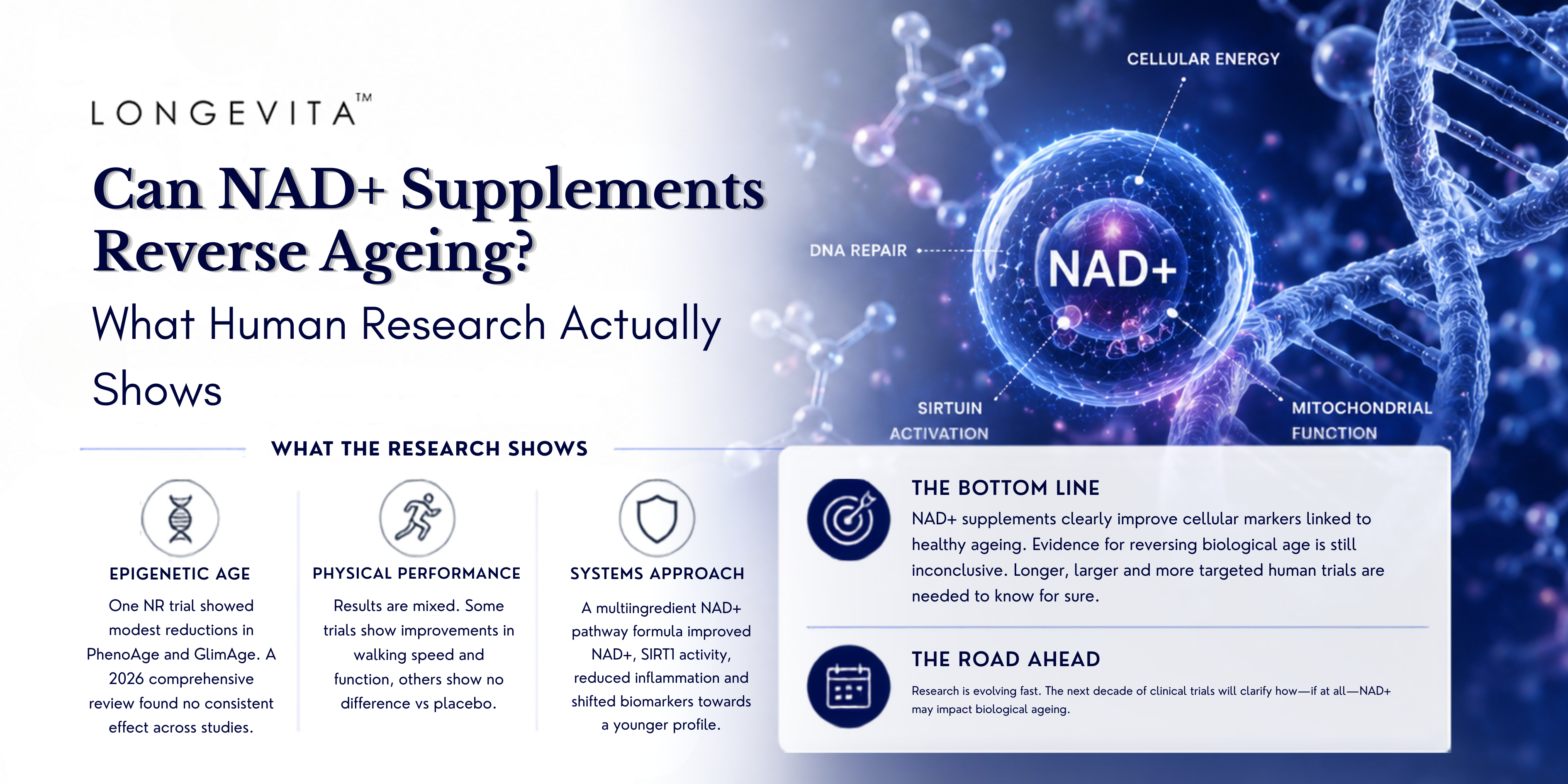
A randomised, placebo-controlled trial of nicotinamide riboside in older adults with mild cognitive impairment found that NR significantly increased blood NAD+ concentrations and, notably, showed a modest NR-associated increase in DNA methylation alongside a corresponding reduction in epigenetic age, measured using both PhenoAge and GrimAge clocks (Orr et al., 2024). This is one of the more encouraging findings specific to an NAD+ precursor and validated biological age measurement.
However, a comprehensive 2026 review cataloguing interventions shown to decrease next-generation epigenetic ageing clocks reached a different conclusion for the same compound: it found that nicotinamide riboside, alongside several other interventions including rapamycin and senolytics, showed no detectable effect on epigenetic ageing clocks across the broader body of evidence considered (Bautmans et al., 2026).
This apparent contradiction is not a flaw in the science. It reflects a real and important pattern: single studies, particularly smaller trials, can show promising signals that do not consistently replicate across the wider literature, which is precisely why comprehensive reviews weighing multiple studies together are considered more reliable than any individual result.
What About Physical Performance and Functional Markers?
Beyond epigenetic clocks, researchers have also examined whether NAD+ precursors improve functional markers associated with ageing, such as physical performance, walking speed and metabolic health.
A systematic review of ten randomised controlled trials involving 437 patients, with a mean age of 58 and follow-up periods averaging under ten weeks, examined NMN supplementation and physical performance outcomes specifically (Chakraborty et al., 2025). Findings across this body of trials were mixed: some studies reported improvements in measures like walking speed, while others found no significant change compared to placebo, again underscoring how outcomes can vary meaningfully depending on population, dose and trial duration.
A separate trial examining NR supplementation in cognitively impaired older adults found that NR significantly increased blood NAD+ concentrations but did not improve cognition and walking speed; in the placebo group actually improved more than in the NR group across the study, a result researchers attributed to a practice effect rather than any adverse impact of NR itself (Orr et al., 2024).
The Nuchido TIME+ Study: A Systems-Based Approach
Not all research relies on a single NAD+ precursor in isolation. A notable 2024 study evaluated a systems-based supplement designed to target multiple points in the NAD+ salvage pathway simultaneously, rather than supplying just one precursor molecule (Braidy et al., 2024).
In a double-blind, randomised, crossover trial, this multi-ingredient approach increased whole-blood NAD+ concentration, and this was associated with several additional, biologically meaningful changes: an increase in SIRT1 and NAMPT activity in peripheral blood cells, lower concentrations of pro-inflammatory cytokines including interleukin-2, a reduction in glycated serum protein, and a shift in the glycosylation profile of immunoglobulin G toward a pattern associated with younger biological age (Braidy et al., 2024).
This finding is instructive. It suggests that supporting multiple points along the NAD+ salvage pathway simultaneously, rather than a single precursor alone, may produce a broader constellation of favourable biological changes, even though the researchers themselves describe these outcomes as "likely to promote a healthier ageing trajectory" rather than definitive proof of reversed biological age.
Why Do Results Vary So Much Between Studies?
Several factors help explain the inconsistency across this body of research, and understanding them is key to interpreting any individual claim responsibly.
Trial duration is often short. Most NAD+ precursor trials to date have run for a matter of weeks, sometimes as few as four, while biological ageing is understood to develop and potentially reverse over a much longer timescale (Chakraborty et al., 2025).
Populations differ substantially. Trials span healthy older adults, individuals with mild cognitive impairment, chronic kidney disease patients and others, making direct comparisons across studies difficult.
Blood NAD+ may not reflect tissue-level or epigenetic change. As with other NAD+ research, a rise in circulating NAD+ does not automatically confirm equivalent change within the specific cells or tissues where epigenetic ageing is measured.
Single-ingredient versus systems-based approaches differ. The more encouraging biomarker findings in research like the Nuchido TIME+ trial came from a multi-point intervention targeting the salvage pathway broadly, rather than one precursor alone (Braidy et al., 2024).
So, Can NAD+ Supplements Reverse Ageing?
Based on current evidence, the honest answer is: not conclusively, and not as a guaranteed, reproducible effect across the field. Some individual studies show encouraging epigenetic and biomarker changes; others, including a comprehensive 2026 review, found no detectable effect on validated epigenetic clocks for the same compound.
What the evidence does robustly support is that NAD+ precursors reliably raise measurable NAD+ levels, and that broader, systems-based approaches targeting multiple points in NAD+ metabolism have shown promising, if preliminary, effects on inflammatory and glycation-related biomarkers associated with biological ageing (Braidy et al., 2024; Yang et al., 2025).
This distinction, between a reliable biochemical effect and an unproven claim of reversed ageing, is exactly the kind of nuance responsible longevity science should communicate clearly.
Supporting Healthy Ageing
Because no single supplement has been conclusively shown to reverse biological ageing, supporting healthy ageing continues to rely most robustly on foundational lifestyle factors.
Diet and lifestyle interventions combining exercise, sleep, nutrition and stress management have themselves shown measurable reductions in epigenetic age in randomised trials, reinforcing that biological ageing responds to multiple combined inputs rather than any single molecule (Fitzgerald et al., 2021). Regular exercise, quality sleep and stress management remain the most consistently evidence-backed contributors to healthy cellular ageing available today.
Supplements may provide additional support, but they work best as part of a broader, multi-pathway approach, addressing NAD+ metabolism alongside the many other factors that influence biological age.
How Longevita™ Approaches NAD+ and Cellular Ageing
The research summarised here reinforces an important principle: because single-ingredient NAD+ precursor trials have produced inconsistent results, a systems-based approach targeting multiple interconnected pathways is a more evidence-aligned strategy than relying on NAD+ precursors alone.
This is the scientific rationale behind The Longevita™ Supplement, a doctor-formulated, 12-ingredient longevity formula designed to target the key hallmarks of ageing by promoting cellular energy, helping manage senescent cell burden, and strengthening antioxidant and inflammation defence systems, reflecting the same multi-point philosophy shown to produce broader biomarker benefits in systems-based research.
At its core, Longevita™ combines Nicotinamide Riboside Chloride, which boosts NAD⁺ levels to activate sirtuins and enhance DNA repair, with Nicotinamide, which sustains NAD⁺ pools for mitochondrial energy and antioxidant defence. Rather than relying on these precursors alone, the formula pairs them with Coenzyme Q10, which preserves mitochondrial ATP production and reduces oxidative stress, and Calcium Alpha Ketoglutarate, which enhances mitochondrial energy and reduces inflammaging via epigenetic modulation, directly addressing the inflammatory and glycation-related pathways implicated in biological ageing research.
To further support the cellular renewal processes associated with healthier ageing trajectories, Longevita™ includes Trans-Resveratrol, which activates SIRT1 for mitochondrial function while promoting autophagy and DNA repair, and Pterostilbene, which activates SIRT1/AMPK pathways to enhance mitochondrial biogenesis with superior bioavailability. Fisetin supports the clearance of senescent cells, Piperine upregulates antioxidant enzymes and enhances mitochondrial biogenesis via PGC-1α, and Ginseng activates antioxidant pathways and promotes autophagy via SIRT1 and FOXO signalling. L-Theanine, Lutein and Hyaluronic Acid extend the formula's support to cognition, visual health and skin.
Formulated by a doctor and longevity specialist, and manufactured in a GMP-certified, USFDA-registered facility with third-party testing for potency and contaminants, Longevita™ is built on the premise that supporting healthy cellular ageing requires addressing multiple interconnected pathways together, not making unproven claims about reversing ageing through a single ingredient.
The Bottom Line
Claims that NAD+ supplements can reverse ageing outpace what current human research conclusively shows. While NAD+ precursors reliably raise measurable NAD+ levels, their effects on validated biological age measures, including epigenetic clocks, are genuinely mixed across the literature, with some studies showing encouraging signals and comprehensive reviews finding no detectable effect for the same compounds. Systems-based approaches targeting multiple points in NAD+ metabolism have shown more consistent, though still preliminary, improvements in inflammatory and glycation-related biomarkers linked to healthier ageing trajectories.
Understanding this distinction between reliable biochemistry and unproven claims of ageing reversal is essential to engaging with longevity science honestly, and reinforces the value of a comprehensive, multi-pathway approach over any single-ingredient promise.
Explore The Longevita™ Supplement, a doctor-formulated, 12-ingredient longevity formula designed to support NAD+ status, mitochondrial function and cellular resilience as part of a daily routine.
FAQs
1. Do NAD+ supplements actually reverse ageing?
Current evidence does not conclusively support this claim. NAD+ precursors reliably raise measurable NAD+ levels, but their effects on validated biological age measures like epigenetic clocks are mixed, with some studies showing benefits and comprehensive reviews finding no detectable effect for the same compounds.
2. What is an epigenetic clock?
Epigenetic clocks, such as the Horvath, PhenoAge and GrimAge clocks, analyse patterns of DNA methylation to estimate a person's biological age independent of chronological age, and are considered the current gold standard for measuring biological ageing in research.
3. Are systems-based supplements more effective than single NAD+ precursors?
Some research suggests so. A study targeting multiple points in the NAD+ salvage pathway simultaneously found broader biomarker benefits, including reduced inflammatory cytokines and favourable glycation changes, compared to what single-precursor trials typically report.
4. What does reliably improve biological age according to research?
Combined diet and lifestyle interventions, including exercise, sleep, nutrition and stress management, have shown measurable reductions in epigenetic age in randomised trials, representing some of the most consistently replicated findings in this area.
References
Bautmans, I. et al. (2026) 'Turning back time: a comprehensive list of interventions that decrease next-generation epigenetic ageing clocks in humans', Frontiers in Genetics, 17, Article 1836446.
Braidy, N. et al. (2024) 'The use of a systems approach to increase NAD+ in human participants', npj Ageing, 10, 8.
Chakraborty, A. et al. (2025) 'Improved physical performance parameters in patients taking nicotinamide mononucleotide (NMN): a systematic review of randomised controlled trials', Cureus.
Fitzgerald, K.N., Hodges, R., Hanes, D., Stack, E., Cheishvili, D., Szyf, M., Henkel, J., Twedt, M.W., Giannopoulou, D., Herdell, J., Logan, S. & Bradley, R. (2021) 'Potential reversal of epigenetic age using a diet and lifestyle intervention: a pilot randomised clinical trial', Ageing, 13(7), pp. 9419–9432.
Orr, M.E., Kotkowski, E., Ramirez, P., Bair-Kelps, D., Liu, Q., Brenner, C. et al. (2024) 'A randomised placebo-controlled trial of nicotinamide riboside in older adults with mild cognitive impairment', GeroScience, 46(1), pp. 665–682.
Yang, Q. et al. (2025) 'An updated review on the mechanisms, pre-clinical and clinical comparisons of nicotinamide mononucleotide (NMN) and nicotinamide riboside (NR)', Food Frontiers, Wiley Online Library.