NAD+ and Inflammaging: How Chronic Inflammation May Affect Cellular Energy
Inflammation has an image problem. Most people associate it with a swollen ankle or a sore throat, something acute, visible and temporary. But there is a second, far quieter form of inflammation that doesn't resolve, doesn't announce itself with obvious symptoms, and appears to intensify steadily with age.
Researchers call this inflammaging, a term first coined in 2000 to describe the chronic, low-grade, systemic inflammation that develops in the absence of overt infection (Franceschi & Campisi, 2014). It has since become recognised as one of the most consequential features of biological ageing, and increasingly, one of the most closely linked to declining levels of nicotinamide adenine dinucleotide, commonly known as NAD+ (Chini et al., 2020).
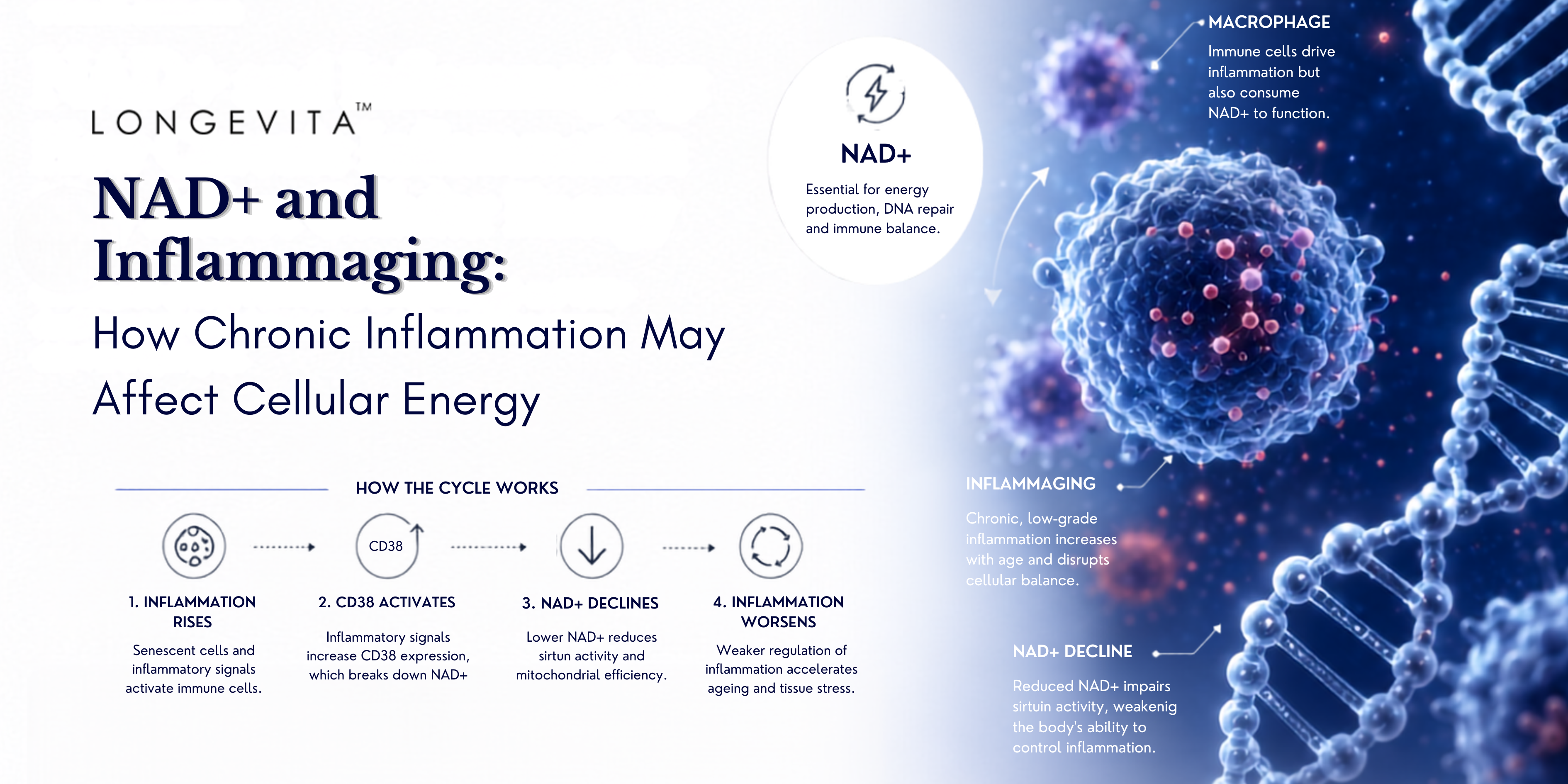
Understanding this relationship matters because it appears to run in both directions. Inflammation drives NAD+ decline, and NAD+ decline may, in turn, worsen inflammation, creating a self-reinforcing cycle that researchers are only beginning to fully map.
What Is Inflammaging, Exactly?
Inflammaging is distinct from the acute inflammatory response the body mounts against infection or injury. It is sterile, meaning it isn't triggered by a pathogen, and it is chronic, persisting at a low but measurable level over years or decades (Chen, Xie & Zhu, 2023).
Emerging evidence points to a bidirectional and cyclical relationship between inflammaging and many of the recognised hallmarks of biological ageing, including mitochondrial dysfunction, cellular senescence and genomic instability, with these processes appearing to reinforce one another over time (Chen, Xie & Zhu, 2023). NAD+ metabolism sits at a particularly important junction within this network, given its role in energy production, immune cell function and cellular signalling.
Why Does Inflammation Affect NAD+ in the First Place?
The connection between inflammation and NAD+ centres largely on immune cells, particularly macrophages, and their heavy reliance on NAD+-dependent metabolic pathways to carry out their functions (Mann, Stavrou & Dimeloe, 2025).
Macrophages are intimately involved in initiating and resolving inflammation, and their dysregulation with age is considered a primary contributor to inflammaging (Hogan et al., 2019). As macrophages age, they tend to develop a heightened state of basal inflammation alongside either diminished or hyperactive inflammatory responses, changes that appear to be driven by metabolic and epigenetic shifts tightly connected to NAD+ availability (Hogan et al., 2019).
The CD38 Connection: A Surprising Discovery
Central to this relationship is CD38, an enzyme expressed on immune cells that functions as the primary NAD+-degrading enzyme in mammalian tissues (Chini et al., 2020).
In a widely cited 2020 study from the Buck Institute, researchers set out to test the hypothesis that CD38 activation would be driven specifically by age-related inflammation. What they found was more surprising: CD38 activation occurred in response to both acute and chronic, age-related inflammation, suggesting that any inflammatory trigger, not just the slow accumulation of age-related changes, is capable of activating this NAD+-depleting pathway (Covarrubias et al., 2020).
The same research found that senescent cells, cells that have stopped dividing in response to DNA damage, release a distinctive mixture of pro-inflammatory proteins known as the senescence-associated secretory phenotype, or SASP. These SASP signals were shown to directly induce CD38 expression in nearby macrophages, establishing a clear mechanistic link between cellular senescence, inflammation and NAD+ decline (Covarrubias et al., 2020). Researchers have described this dynamic using a memorable analogy: if cellular metabolism is like a cash economy, NAD+ functions as the armoured trucks that transport currency between institutions. When those transport routes are disrupted, the entire economy can grind to a halt.
Further supporting this connection, research shows that inflammatory cytokines, bacterial endotoxins and interferon signalling can all directly trigger increased CD38 production, reinforcing how broadly and rapidly the immune system's inflammatory signalling can draw down the cellular NAD+ pool (Chen, Xie & Zhu, 2023).
How Does Falling NAD+ Then Worsen Inflammation?
This is where the cycle closes. Just as inflammation depletes NAD+, declining NAD+ availability appears to impair the cell's ability to regulate and resolve inflammation, particularly through its effects on sirtuins.
Sirtuins are NAD+-dependent proteins with well-documented anti-inflammatory and metabolic regulatory properties (Chen, Xie & Zhu, 2023). Research shows that intracellular NAD+ levels regulate tumour necrosis factor protein synthesis in a sirtuin-dependent manner, meaning that when NAD+ becomes scarce, sirtuin activity falls, and the cell's capacity to keep inflammatory signalling in check may be correspondingly weakened.
This effect is not limited to distant tissues acting in isolation. Research on hyperammonemia, a metabolic stress that increases with age, found that elevated ammonia can inhibit a key enzyme complex in the mitochondrial electron transport chain responsible for converting NADH back to NAD+, resulting in a lower NAD+/NADH ratio, impaired SIRT3 function, and accelerated cellular senescence, accompanied by increased inflammatory gene activation (Chen, Xie & Zhu, 2023). This illustrates how multiple metabolic stressors can converge on the same NAD+-sirtuin axis to reinforce inflammaging from several directions simultaneously.
NAD+, Immune Cell Metabolism and Ageing
Beyond CD38 and sirtuins, NAD+ plays a broader, foundational role in shaping how immune cells behave as they age.
NAD+ metabolism supports the metabolic reprogramming that macrophages and T cells undergo during differentiation and activation, a process essential to mounting an effective, proportionate immune response (Mann, Stavrou & Dimeloe, 2025). This reprogramming determines whether immune cells rely primarily on oxidative phosphorylation or glycolysis to meet their energy demands, a metabolic switch that is itself heavily dependent on NAD+ availability and the redox balance it helps maintain.
When NAD+ availability is compromised, this reprogramming may become less efficient, potentially contributing to the dysregulated, imbalanced immune responses increasingly observed with age, including both a heightened baseline inflammatory state and, paradoxically, a reduced capacity to mount an effective response against genuine threats (Hogan et al., 2019).
This has made NAD+ metabolism a genuine area of therapeutic interest beyond longevity research alone, with direct NAD+ augmentation via the salvage and Preiss-Handler pathways currently being investigated as a potential strategy to improve healthspan in inflammation-linked diseases more broadly, including autoimmune conditions (Wang et al., 2024).
Does Raising NAD+ Help Reduce Inflammation?
Preclinical and translational research offers encouraging, though still developing, evidence on this question.
In the context of cardiovascular disease, therapeutic elevation of NAD+ levels has been shown to reduce chronic low-grade inflammation, reactivate autophagy and mitochondrial biogenesis, and enhance oxidative metabolism in vascular cells, findings replicated in both human and rodent studies of vascular disorders (Zhou et al., 2024). In preclinical models, boosting NAD+ has also been associated with expanded healthspan, prevention of metabolic syndrome, and reduced blood pressure, suggesting the NAD+-inflammation relationship extends well beyond a single organ system (Zhou et al., 2024).
These findings reinforce the idea that supporting NAD+ status may help interrupt, at least partially, the self-reinforcing cycle between inflammation and NAD+ decline, though researchers are careful to note that inflammaging is influenced by many interacting factors beyond NAD+ metabolism alone.
Supporting Healthy Ageing
Because inflammaging and NAD+ decline appear to reinforce one another, supporting healthy cellular ageing works best as a broad strategy addressing both sides of this cycle simultaneously.
Regular sleep has a particularly direct connection to this relationship: NAD+ levels follow a natural 24-hour rhythm governed by circadian proteins, and poor sleep patterns have been shown to reduce activity of NAMPT, the rate-limiting enzyme in NAD+ salvage synthesis, which normally peaks during darkness (Ramsey et al., 2009). Regular exercise, balanced nutrition and stress management are also associated with lower chronic inflammatory burden and more favourable NAD+ metabolism over time.
Supplements may provide additional support, but they work best as part of a broader, multi-pathway approach addressing both inflammatory drivers and NAD+ metabolism together.
How Longevita™ Addresses the Inflammaging-NAD+ Cycle
The research summarised here points to a clear conclusion: because inflammation and NAD+ decline reinforce each other, supporting cellular health effectively requires addressing both sides of this cycle together, not simply raising NAD+ in isolation.
This is the scientific rationale behind The Longevita™ Supplement, a doctor-formulated, 12-ingredient longevity formula designed to target the key hallmarks of ageing by promoting cellular energy, helping manage senescent cell burden, and strengthening antioxidant and inflammation defence systems.
At its core, Longevita™ combines Nicotinamide Riboside Chloride, which boosts NAD⁺ levels to activate sirtuins and enhance DNA repair, with Nicotinamide, which sustains NAD⁺ pools for mitochondrial energy and antioxidant defence, directly replenishing the NAD+ supply consumed during inflammatory activation. Alongside these precursors, Calcium Alpha Ketoglutarate reduces inflammaging via epigenetic modulation, addressing the inflammatory side of the cycle directly, while Fisetin supports the clearance of senescent cells, the very cells shown to release SASP signals that induce CD38 expression and drive NAD+ depletion.
To further support the antioxidant and mitochondrial systems affected by chronic inflammatory pressure, Longevita™ includes Trans-Resveratrol, which activates SIRT1 for mitochondrial function while promoting autophagy and DNA repair, and Pterostilbene, which activates SIRT1/AMPK pathways to enhance mitochondrial biogenesis with superior bioavailability, reinforcing the sirtuin activity shown to help regulate inflammatory signalling. Coenzyme Q10 preserves mitochondrial ATP production and reduces oxidative stress, Piperine upregulates antioxidant enzymes and enhances mitochondrial biogenesis via PGC-1α, and Ginseng activates antioxidant pathways and promotes autophagy via SIRT1 and FOXO signalling. L-Theanine, Lutein and Hyaluronic Acid extend the formula's support to cognition, visual health and skin.
Formulated by a doctor and longevity specialist, and manufactured in a GMP-certified, USFDA-registered facility with third-party testing for potency and contaminants, Longevita™ is built on the premise that supporting healthy cellular ageing requires addressing inflammation and NAD+ metabolism together, given how tightly interconnected these two systems have been shown to be.
The Bottom Line
Inflammaging and NAD+ decline appear to exist in a genuine, bidirectional relationship. Chronic low-grade inflammation, driven partly by senescent cells and their inflammatory secretions, activates CD38 and depletes cellular NAD+, while falling NAD+ availability weakens sirtuin-mediated control over inflammatory signalling, allowing the cycle to continue. Research suggests this connection extends across immune cell metabolism, cardiovascular health and mitochondrial function, making it one of the more foundational relationships in ageing biology.
While no single intervention can fully interrupt this cycle, understanding how inflammation and NAD+ metabolism reinforce one another reinforces the value of a comprehensive, multi-pathway approach to supporting cellular energy and long-term healthspan.
Explore The Longevita™ Supplement, a doctor-formulated, 12-ingredient longevity formula designed to support NAD+ status, mitochondrial function and cellular resilience as part of a daily routine.
FAQs
-
What is inflammaging?
Inflammaging is chronic, low-grade, systemic inflammation that develops with age in the absence of infection. It is distinct from acute inflammation and is increasingly linked to declining NAD+ levels and multiple hallmarks of biological ageing.
-
How does inflammation lower NAD+ levels?
Inflammatory signals, including cytokines and senescent cell secretions, activate CD38, the primary NAD+-degrading enzyme in the body. Research shows CD38 activation occurs in response to both acute and chronic, age-related inflammation.
-
Does low NAD+ make inflammation worse?
Evidence suggests it can. NAD+ is required for sirtuin activity, which helps regulate inflammatory signalling. When NAD+ becomes scarce, sirtuin-dependent control over inflammatory processes, including cytokine production, may be weakened.
-
Can raising NAD+ help reduce chronic inflammation?
Some preclinical and translational research suggests therapeutic NAD+ elevation can reduce chronic low-grade inflammation and support mitochondrial function, though researchers note inflammaging involves multiple contributing factors beyond NAD+ alone.
References
Chen, X., Xie, X. & Zhu, Q. (2023) 'Chronic inflammation and the hallmarks of aging', Molecular Metabolism, 84, 101755.
Chini, C.C.S., Peclat, T.R., Warner, G.M., Kashyap, S., Espindola-Netto, J.M., de Oliveira, G.C., Gomez, L.S., Hogan, K.A., Tarragó, M.G., Puranik, A.S., Agorrody, G., Thompson, K.L., Dang, K., Clarke, S., Childs, B.G., Kanamori, K.S., Witte, M.A., Vidal, P., Kirkland, J.L., De Cabo, R. & Chini, E.N. (2020) 'CD38 ecto-enzyme in immune cells is induced during aging and regulates NAD+ and NMN levels', Nature Metabolism, 2(11), pp. 1284–1304.
Covarrubias, A.J., Kale, A., Perrone, R., Lopez-Dominguez, J.A., Pisco, A.O., Kasler, H.G., Schmidt, M.S., Heckenbach, I., Kwok, R., Wiley, C.D., Wong, H.S., Gibbs, E., Iyer, S.S., Basisty, N., Wu, Q., Kim, I.J., Silva, E., Vitangcol, K., Shin, K.O., Lee, Y.M., Riley, R., Ben-Sahra, I., Ott, M., Schilling, B., Scheibye-Knudsen, M., Verdin, E. & Newman, J.C. (2020) 'Senescent cells promote tissue NAD+ decline during ageing via the activation of CD38+ macrophages', Nature Metabolism, 2(11), pp. 1265–1283.
Franceschi, C. & Campisi, J. (2014) 'Chronic inflammation (inflammaging) and its potential contribution to age-associated diseases', Journals of Gerontology: Series A, 69(Suppl 1), pp. S4–S9.
Hogan, K.A., Kang, K.A., Chini, C.C.S. & Chini, E.N. (2019) 'Macrophage immunometabolism and inflammaging: roles of mitochondrial dysfunction, cellular senescence, CD38 and NAD', Immunometabolism, 2(3), e200018.
Mann, R., Stavrou, V. & Dimeloe, S. (2025) 'NAD+ metabolism and function in innate and adaptive immune cells', Journal of Inflammation, 22, 30.
Ramsey, K.M., Yoshino, J., Brace, C.S., Abrassart, D., Kobayashi, Y., Marcheva, B., Hong, H.K., Chong, J.L., Buhr, E.D., Lee, C., Takahashi, J.S., Imai, S. & Bass, J. (2009) 'Circadian clock feedback cycle through NAMPT-mediated NAD+ biosynthesis', Science, 324(5927), pp. 651–654.
Wang, S. et al. (2024) 'Targeting NAD+ metabolism to modulate autoimmunity and inflammation', Journal of Immunology, 212(7), pp. 1043–1050.
Zhou, B. et al. (2024) 'NAD+ metabolism and therapeutic strategies in cardiovascular diseases', Frontiers in Cardiovascular Medicine.