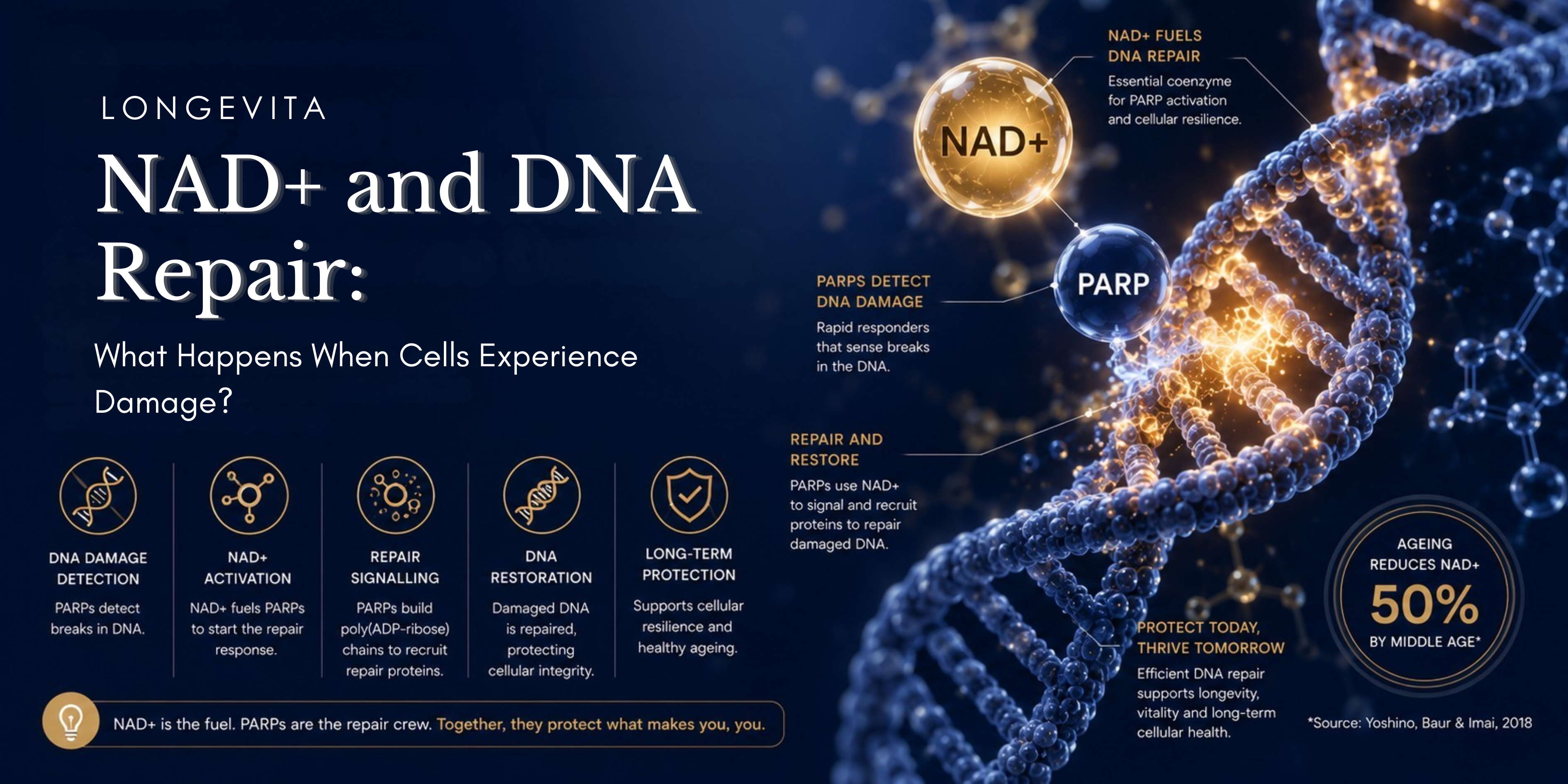
NAD+ and DNA Repair: What Happens When Cells Experience Damage?
Many of us think of ageing in terms of what we can see: energy levels, skin, stamina. Far less visible, but arguably more fundamental, is what happens inside our cells every single day, particularly to our DNA.
Every cell in the body sustains DNA damage constantly, from sunlight, metabolic by-products, environmental toxins and simply the process of cell division itself. Left unrepaired, this damage accumulates and is now recognised as one of the central drivers of cellular ageing (López-Otín et al., 2013).
Repairing this damage is not free. It requires energy, and specifically, it requires nicotinamide adenine dinucleotide, commonly known as NAD+.
At the centre of this process are PARPs, a family of DNA repair enzymes that rely almost entirely on NAD+ to function. Understanding how NAD+, PARPs and DNA repair interact has become one of the more clinically significant threads in longevity science (Sun, Wang, Xu & Zhao, 2025).
Why Does DNA Damage Matter as We Age?
The human genome is under constant assault. Estimates suggest that individual cells experience tens of thousands of DNA lesions each day, ranging from single-strand breaks to more serious double-strand breaks (Kobayashi & Imanaka, 2024).
Most of this damage is repaired quickly and efficiently. However, research indicates that the accumulation of unrepaired or poorly repaired DNA damage over decades contributes to cellular dysfunction, senescence and many age-related conditions (López-Otín et al., 2013).
Because DNA repair pathways depend heavily on NAD+, the availability of this coenzyme has a direct bearing on how effectively cells can respond to damage as we get older.
What Are PARPs?
Poly (ADP-ribose) polymerases, or PARPs, are a family of enzymes that act as some of the body's fastest first responders to DNA damage (Kobayashi & Imanaka, 2024).
Within minutes of a DNA strand break occurring, PARP enzymes, particularly PARP1, bind to the damaged site and begin recruiting the repair machinery needed to fix it.
Think of PARP1 as an alarm system wired directly into the genome. The moment damage is detected, it activates, using NAD+ as its essential fuel source to signal other repair proteins to the site (Kobayashi & Imanaka, 2024).
Without adequate NAD+, this alarm system cannot function properly, and the downstream repair process is delayed or impaired.
How Do PARPs Use NAD+?
PARP1 does not simply consume NAD+ as background fuel. It uses NAD+ directly as a substrate, breaking it down to build long chains of poly (ADP-ribose) on itself and on nearby proteins at the site of damage (Sun, Wang, Xu & Zhao, 2025).
This process, known as PARylation, acts as a signal that recruits additional repair enzymes and helps loosen the tightly packed DNA structure so repair machinery can access the damaged site.
Because each repair event consumes measurable quantities of NAD+, tissues undergoing significant or repeated DNA damage can place substantial demand on the local NAD+ pool.
The "Hyperactive PARP" Hypothesis
One of the more compelling explanations for age-related NAD+ decline centres on what researchers describe as the hyperactive PARP hypothesis.
Studies in rodents show that PARP activity is measurably higher in tissues of older animals compared to younger ones, correlating with lower NAD+ availability (ChemRxiv, 2025). Similar patterns have been observed in human fibroblasts and tissues, where PARP activity also appears to rise with donor age.
The hypothesis suggests that as DNA damage accumulates with age, PARP enzymes become increasingly and continuously overactivated, persistently siphoning NAD+ away from other essential processes such as sirtuin signalling and mitochondrial function (ChemRxiv, 2025).
Supporting this idea, research shows that inhibiting PARP activity in aged cells can help restore NAD+ levels, suggesting that PARP overactivation is not simply a symptom of low NAD+, but may be an active contributor to it.
NAD+, PARPs and Sirtuins: Competing for the Same Pool
PARPs are not the only enzymes competing for cellular NAD+. Sirtuins, a family of proteins involved in regulating metabolism, gene expression and cellular stress responses, also depend on NAD+ to function (Sun, Wang, Xu & Zhao, 2025).
Because PARPs and sirtuins draw from the same limited NAD+ pool, excessive PARP activation during periods of high DNA damage can leave less NAD+ available for sirtuin-mediated processes, including further DNA repair support and metabolic regulation.
This competitive relationship helps explain why maintaining adequate NAD+ levels is considered important for supporting multiple interconnected pathways simultaneously, rather than DNA repair in isolation.
Mitochondrial DNA: A Particularly Demanding Case
While much research has focused on nuclear DNA repair, mitochondrial DNA presents its own considerable demands on the NAD+ pool.
Mitochondrial DNA has a limited capacity for repairing double-strand breaks and instead relies heavily on PARP1-mediated repair of single-strand breaks (Kobayashi & Imanaka, 2024). Because mitochondria are also the primary site of cellular energy production, this creates a particularly demanding cycle: repairing mitochondrial DNA consumes NAD+ and ATP, while impaired mitochondrial function due to unrepaired damage can further compromise energy metabolism.
Research on ovarian ageing, for example, has highlighted how this repair-driven depletion cycle may contribute to age-related decline in cellular function in tissues with high and prolonged repair demands (Kobayashi & Imanaka, 2024).
Can NAD+ Precursors Support DNA Repair Capacity?
Because NAD+ cannot be efficiently absorbed in its direct form when taken orally, researchers have focused on precursor molecules that the body converts into NAD+ through the salvage pathway, including nicotinamide mononucleotide (NMN) and nicotinamide riboside.
In one study, aged mice with radiation-induced DNA damage were administered NMN. The intervention was shown to improve hepatic NAD+ concentration alongside PARP1 activity and DNA repair outcomes, suggesting that restoring NAD+ availability can meaningfully support the repair machinery's capacity to function (Rahman et al., 2024).
These findings reflect why NAD+ precursor supplementation has become a significant area of interest within longevity science, particularly for supporting DNA repair capacity, mitochondrial function and cellular resilience as NAD+ levels naturally decline with age.
Supporting Healthy Ageing
While NAD+ and PARP-mediated DNA repair are an important piece of the picture, healthy ageing is influenced by many interacting factors, including oxidative stress, chronic inflammation and mitochondrial health.
Regular exercise, quality sleep, balanced nutrition, sun protection and stress management all support the body's natural capacity for genomic maintenance.
Supplements may provide additional support, but they work best as part of a broader, multi-pathway approach to healthy cellular ageing.
How Longevita™ Supports NAD+-Dependent DNA Repair
The research summarised here highlights a central challenge: DNA repair is essential, but it is also one of the most NAD+-intensive processes in the body. Supporting this system meaningfully requires more than simply supplying raw NAD+ precursors in isolation.
This is the scientific rationale behind The Longevita™ Supplement, a doctor-formulated, 12-ingredient longevity formula designed to support cellular health across multiple interacting systems.
At its core, Longevita™ combines Nicotinamide Riboside Chloride and Nicotinamide (niacin) to support the NAD+ salvage pathway, helping replenish the NAD+ pool that PARP enzymes rely on during repair. Alongside these precursors, the formula includes Coenzyme Q10 and Calcium Alpha Ketoglutarate to support mitochondrial function and cellular energy production, which is particularly relevant given the demands that mitochondrial DNA repair places on NAD+ and ATP availability.
To help address the oxidative stress that contributes to DNA damage in the first place, Longevita™ includes Trans-Resveratrol and Pterostilbene, polyphenols studied for their role in antioxidant defence and healthy ageing pathways, alongside Fisetin, studied for its role in cellular cleanup and renewal. Piperine supports the absorption of these co-ingredients, while L-Theanine, Ginseng, Lutein and Hyaluronic Acid extend support to cognition, focus, visual health and skin, reflecting the wide-reaching effects of cellular ageing across the body.
Formulated by a doctor and longevity specialist, and manufactured in a GMP-certified, USFDA-registered facility with third-party testing for potency and contaminants, Longevita™ is built on the premise that supporting DNA repair capacity requires addressing NAD+ synthesis, mitochondrial resilience and oxidative stress together, not in isolation.
The Bottom Line
DNA damage is a constant and unavoidable feature of cellular life, and repairing it depends heavily on NAD+-fuelled PARP enzymes. As we age, rising PARP activity appears to place growing demand on the NAD+ pool, contributing to the broader decline in NAD+ availability associated with ageing.
While no supplement can stop DNA damage from occurring, understanding the NAD+–PARP–DNA repair relationship helps explain why maintaining healthy NAD+ status is considered relevant to genomic stability, mitochondrial function and long-term cellular resilience. Combined with healthy lifestyle habits, this may help support wellbeing and long-term healthspan.
Explore The Longevita™ Supplement, a doctor-formulated, 12-ingredient longevity formula designed to support NAD+ status, mitochondrial function and cellular resilience as part of a daily routine.
FAQs
1. Why does DNA repair require NAD+?
PARP enzymes, particularly PARP1, use NAD+ directly as a substrate to signal and recruit DNA repair machinery to damaged sites. Without adequate NAD+, this repair process is delayed or impaired.
2. What is the "hyperactive PARP" hypothesis?
It is the theory that age-related NAD+ decline is partly driven by chronically overactive PARP enzymes continuously consuming NAD+ in response to accumulating DNA damage, leaving less available for other NAD+-dependent processes like sirtuin signalling.
3. Does mitochondrial DNA place extra demand on NAD+?
Yes. Mitochondrial DNA has limited capacity to repair double-strand breaks and relies heavily on PARP1-mediated repair, which consumes NAD+ and ATP, potentially compromising the very energy production it depends on.
4. Can NAD+ precursors support DNA repair capacity?
Research in aged mice has shown that NMN supplementation can improve NAD+ concentration alongside PARP1 activity and DNA repair outcomes, though ongoing research continues to explore how this translates to long-term human health.
References
ChemRxiv (2025) 'Boosting NAD+ for anti-ageing: mechanisms, evidence, and implications for future trials', ChemRxiv preprint, DOI: 10.26434/chemrxiv-2025-nl80r.
Kobayashi, H. & Imanaka, S. (2024) 'Mitochondrial DNA damage and its repair mechanisms in ageing oocytes', International Journal of Molecular Sciences, 25(23), 13144.
López-Otín, C., Blasco, M.A., Partridge, L., Serrano, M. & Kroemer, G. (2013) 'The hallmarks of ageing', Cell, 153(6), pp. 1194–1217.
Rahman, M.H., Bhusal, A., Kim, J.H., Jha, M.K., Song, G.J., Go, Y., Jang, I.S., Lee, I.K. & Suk, K. (2024) 'Role and potential mechanisms of nicotinamide mononucleotide in ageing', Frontiers in Ageing Neuroscience, 16, Article 1362151.
Sun, J.Y., Wang, Z.F., Xu, W.H. & Zhao, J. (2025) 'NAD+ glycohydrolases-CD38 as a therapeutic target in ageing: physiological roles, molecular mechanisms, and future opportunities in anti-ageing research', Biochemical and Biophysical Research Communications, in press.