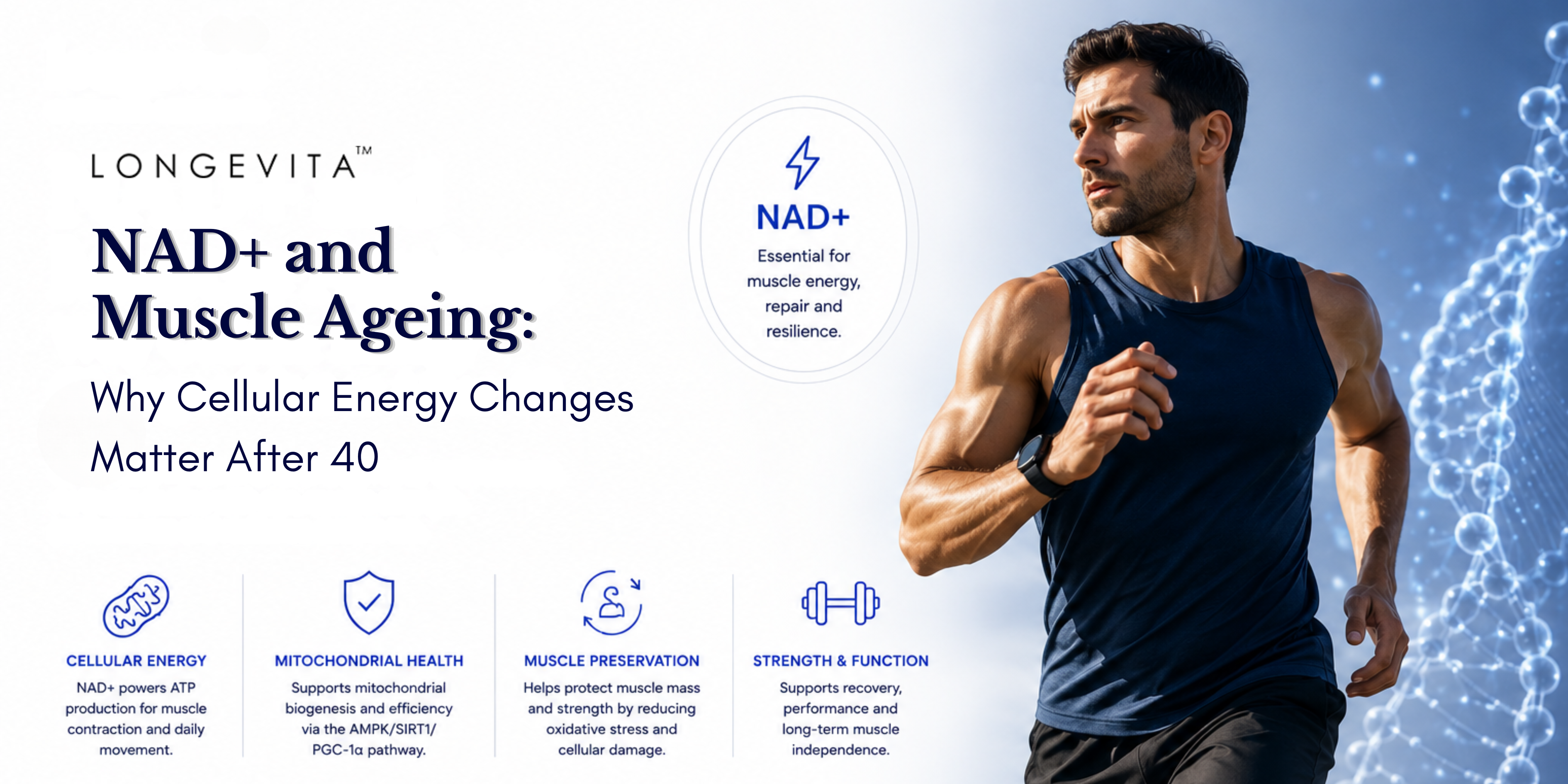
NAD+ and Muscle Ageing: Why Cellular Energy Changes Matter After 40
Muscle loss doesn't announce itself. There's no single moment where strength noticeably drops; instead, it unfolds gradually, often long before it becomes apparent in daily life. By the time reduced strength or slower recovery is obvious, the underlying biological changes have typically been building for years.
Research shows that muscle mass and strength decline by roughly three to eight per cent per decade after midlife, with the rate of loss accelerating further after age 60 (de Guia et al., 2019). This gradual, cumulative process, when it becomes clinically significant, is known as sarcopenia, the age-related loss of skeletal muscle mass, strength and function (Lo Buglio, Bellanti & Vendemiale, 2024).
At the cellular level, one molecule sits close to the centre of this story: nicotinamide adenine dinucleotide, commonly known as NAD+. Understanding its role in muscle metabolism helps explain why cellular energy changes after 40 matter far more than they might initially seem.
Why Does Muscle Depend So Heavily on NAD+?
Skeletal muscle is one of the most metabolically active tissues in the body, requiring a constant, reliable supply of ATP to support contraction, repair and daily movement. This energy is generated primarily through mitochondrial oxidative metabolism, a process for which NAD+ is an essential electron carrier (Affourtit et al., 2024).
Because muscle mitochondria are so numerous and so active, skeletal muscle is particularly sensitive to disruptions in NAD+ availability compared to less metabolically demanding tissues. NAD+ also fuels sirtuins, proteins that regulate mitochondrial biogenesis and metabolic efficiency within muscle cells, adding a second layer of dependency beyond direct energy production (Sun, Wang, Xu & Zhao, 2025).
What Happens to Muscle NAD+ with Age?
Direct evidence comes from human muscle biopsy studies, which offer a more precise picture than blood-based measurements alone.
A large study analysing muscle biopsies from 119 older men with sarcopenia across three distinct populations in Singapore, the United Kingdom and Jamaica found reproducible evidence of mitochondrial bioenergetic dysfunction in sarcopenic muscle, including fewer mitochondria, reduced respiratory complex activity, and low NAD+ levels driven by disrupted NAD+ biosynthesis and salvage pathways (Gonzalez-Freire et al., 2020).
This cross-ethnic consistency is notable. It suggests that reduced NAD+ biosynthesis in ageing muscle is not an isolated or population-specific finding, but a recurring feature of sarcopenic muscle biology observed across genetically and geographically diverse groups.
How Does Reduced NAD+ Contribute to Sarcopenia?
Researchers describe sarcopenia as fundamentally linked to disrupted myocellular bioenergetics and redox balance, with mitochondrial dysfunction now recognised as a hallmark of ageing muscle (Affourtit et al., 2024).
When NAD+ availability falls, several interconnected consequences follow. Mitochondrial biogenesis, the process by which cells generate new mitochondria, becomes less efficient, partly because NAD+-dependent sirtuins are needed to activate this process. Sarcopenic muscle also shows low signalling through PGC-1α and ERRα, master regulators of oxidative metabolism and mitochondrial maintenance that depend on upstream activation by NAD+-fuelled AMPK and SIRT1 (Zhao et al., 2025).
Sarcopenia is also consistently linked with oxidative stress, a condition that both results from and further impairs mitochondrial function, creating a self-reinforcing cycle of declining muscle quality (Affourtit et al., 2024).
The AMPK/SIRT1/PGC-1α Pathway: A Central Axis in Muscle Ageing
One pathway has become particularly central to research on NAD+ and muscle ageing. Activated AMPK and SIRT1 can directly promote PGC-1α activity through phosphorylation and deacetylation, respectively, and PGC-1α subsequently drives the transcription of genes essential for oxidative metabolism and mitochondrial maintenance (Zhao et al., 2025).
Because SIRT1 is entirely NAD+-dependent, this entire regulatory axis is constrained by how much NAD+ is available within muscle cells. Researchers believe this integrated network optimises energy expenditure, enhances metabolic fitness and helps preserve muscle function throughout the ageing process, and that supporting it may help reduce mitochondrial dysfunction and mitigate sarcopenia (Zhao et al., 2025).
What Does Research Show About Raising Muscle NAD+?
Given this mechanistic backdrop, researchers have begun directly testing whether raising NAD+ in ageing muscle produces measurable benefits.
One notable finding comes from exercise research rather than supplementation alone. A study found that aerobic and resistance exercise training reversed the age-dependent decline in NAD+ salvage capacity in human skeletal muscle, demonstrating that the salvage pathway responsible for regenerating NAD+ remains responsive to intervention even in older muscle (de Guia et al., 2019).
Supplementation research is also underway. A feasibility study is currently testing whether acipimox, a licensed medication that also functions as an NAD+ precursor, can raise skeletal muscle NAD+ concentrations in older adults with probable sarcopenia, using muscle biopsy and MRI to directly measure change rather than relying on blood markers alone (Op den Kamp et al., 2024). Earlier research in a different population found that two weeks of acipimox treatment produced significant upregulation of mitochondrial genes involved in oxidative phosphorylation, offering preliminary support for the underlying mechanism.
More broadly, a recent review notes that NAD+ precursors such as nicotinamide riboside and nicotinamide mononucleotide have been evaluated in early human trials, showing modest improvements in fatigue and muscle performance, though researchers are careful to describe these findings as preliminary rather than conclusive (Zhao et al., 2025).
Why "Modest" Findings Still Matter
It's worth being direct about where the evidence currently stands. Human trials on NAD+ precursors and muscle outcomes are still relatively early, and results to date are generally described as modest rather than dramatic.
This does not diminish the underlying biological case. It reflects the reality that sarcopenia develops over decades and involves multiple interacting systems, including hormonal changes, chronic inflammation, reduced protein intake and declining anabolic signalling, alongside NAD+-related mitochondrial dysfunction (Gonzalez-Freire et al., 2020). Addressing one pathway, even a foundational one like NAD+ metabolism, is unlikely to fully reverse a process with such varied contributing causes.
Supporting Healthy Muscle Ageing
Because sarcopenia is multifactorial, supporting muscle health after 40 works best as a combined strategy rather than relying on any single intervention.
Resistance and aerobic exercise remain the most consistently evidence-backed interventions, shown to directly restore NAD+ salvage capacity in ageing muscle (de Guia et al., 2019). Adequate protein intake, vitamin D sufficiency and management of chronic low-grade inflammation are also recognised contributors to preserving muscle plasticity with age (Gonzalez-Freire et al., 2020).
Supplements may provide additional support, but they work best as part of a broader, multi-pathway approach addressing mitochondrial function, oxidative stress and inflammation together.
How Longevita™ Supports Muscle-Relevant Cellular Pathways?
The research summarised here points to a clear conclusion: supporting muscle health at the cellular level requires addressing NAD+ synthesis, mitochondrial biogenesis and oxidative stress together, given how tightly interconnected these systems are within ageing muscle.
This is the scientific rationale behind The Longevita™ Supplement, a doctor-formulated, 12-ingredient longevity formula designed to target the key hallmarks of ageing by promoting cellular energy, helping manage senescent cell burden, and strengthening antioxidant and inflammation defence systems.
At its core, Longevita™ combines Nicotinamide Riboside Chloride, which boosts NAD⁺ levels to activate sirtuins and enhance DNA repair, with Nicotinamide, which sustains NAD⁺ pools for mitochondrial energy and antioxidant defence, both feeding the salvage pathway shown to decline in sarcopenic muscle. Alongside these precursors, Coenzyme Q10 preserves mitochondrial ATP production and reduces oxidative stress directly within muscle mitochondria, while Calcium Alpha Ketoglutarate enhances mitochondrial energy and reduces inflammaging via epigenetic modulation.
To directly support the AMPK/SIRT1/PGC-1α axis central to muscle mitochondrial biogenesis, Longevita™ includes Trans-Resveratrol, which activates SIRT1 for mitochondrial function while promoting autophagy and DNA repair, and Pterostilbene, which activates SIRT1/AMPK pathways to enhance mitochondrial biogenesis with superior bioavailability. Piperine upregulates antioxidant enzymes and enhances mitochondrial biogenesis via PGC-1α, reinforcing this same regulatory pathway, while Fisetin supports the clearance of senescent cells linked to the chronic inflammation associated with sarcopenia. Ginseng activates antioxidant pathways and promotes autophagy via SIRT1 and FOXO signalling, and L-Theanine, Lutein and Hyaluronic Acid extend the formula's support to cognition, visual health and skin, reflecting the wide-reaching effects of cellular ageing across the body.
Formulated by a doctor and longevity specialist, and manufactured in a GMP-certified, USFDA-registered facility with third-party testing for potency and contaminants, Longevita™ is built on the premise that supporting muscle health after 40 requires addressing NAD+ synthesis, mitochondrial function and oxidative stress together, not any single pathway in isolation.
The Bottom Line
Muscle mass and strength decline gradually but measurably after midlife, and mitochondrial dysfunction driven by reduced NAD+ biosynthesis appears to be a central, reproducible feature of this process, confirmed across genetically diverse populations through direct muscle biopsy evidence. The AMPK/SIRT1/PGC-1α pathway offers a compelling mechanistic explanation for how NAD+ availability shapes mitochondrial maintenance in ageing muscle, though human trials on NAD+ precursor supplementation remain early, with modest but encouraging results to date.
Understanding this mechanism reinforces why exercise, alongside a comprehensive, multi-pathway approach to cellular health, remains central to supporting muscle function as we age, rather than relying on any single intervention in isolation.
Explore The Longevita™ Supplement, a doctor-formulated, 12-ingredient longevity formula designed to support NAD+ status, mitochondrial function and cellular resilience as part of a daily routine.
FAQs
1. Why does NAD+ decline in ageing muscle?
Muscle biopsy studies show that sarcopenic muscle has disrupted NAD+ biosynthesis and salvage pathways, alongside fewer mitochondria and reduced mitochondrial respiratory activity, a pattern confirmed across multiple ethnically diverse populations.
2. Can exercise restore NAD+ levels in ageing muscle?
Yes. Research shows that aerobic and resistance exercise training can reverse the age-dependent decline in NAD+ salvage capacity in human skeletal muscle, making it one of the most evidence-backed interventions available.
3. Do NAD+ supplements help with sarcopenia?
Early human trials of NAD+ precursors such as nicotinamide riboside and nicotinamide mononucleotide have shown modest improvements in fatigue and muscle performance, though researchers describe this evidence as preliminary and note sarcopenia involves multiple contributing factors beyond NAD+ alone.
4. What is the AMPK/SIRT1/PGC-1α pathway?
It is a key regulatory network in muscle cells where NAD+-dependent SIRT1 and AMPK activate PGC-1α, a master regulator of mitochondrial maintenance and oxidative metabolism, helping preserve muscle function throughout ageing.
References
Affourtit, C., Carré, J.E., Charlton, A. & Bell, N. (2024) 'Mitochondrial involvement in sarcopenia', Acta Physiologica, 240(3), e14107.
de Guia, R.M., Agerholm, M., Nielsen, T.S., Consitt, L.A., Søgaard, D., Helge, J.W., Larsen, S., Brandauer, J., Houmard, J.A. & Treebak, J.T. (2019) 'Aerobic and resistance exercise training reverses age-dependent decline in NAD+ salvage capacity in human skeletal muscle', Physiological Reports, 7(11), e14139.
Gonzalez-Freire, M., Scalzo, P., D'Agostino, J., Moore, Z.A., Diaz-Ruiz, A., Fabbri, E., Zane, A., Chen, B., Becker, K.G., Lehrmann, E., Zukley, L., Chia, C.W., Tanaka, T., Coen, P.M., Bernier, M. & Ferrucci, L. (2020) 'Mitochondrial oxidative capacity and NAD+ biosynthesis are reduced in human sarcopenia across ethnicities', Nature Communications, 11, 5844.
Lo Buglio, A., Bellanti, F. & Vendemiale, G. (2024) 'The ageing muscle: sarcopenia, mitochondrial function, and redox biology', Journal of Gerontology and Geriatrics, 72(1), pp. 1–10.
Op den Kamp, Y. et al. (2024) 'A study protocol to investigate if acipimox improves muscle function and sarcopenia: an open-label, uncontrolled, before-and-after experimental medicine feasibility study in community-dwelling older adults', BMJ Open.
Sun, J.Y., Wang, Z.F., Xu, W.H. & Zhao, J. (2025) 'NAD+ glycohydrolases-CD38 as a therapeutic target in ageing: physiological roles, molecular mechanisms, and future opportunities in anti-ageing research', Biochemical and Biophysical Research Communications, in press.
Zhao, Y. et al. (2025) 'Sarcopenia and muscle ageing: updated insights into molecular mechanisms and translational therapeutics', Endocrinology and Metabolism.