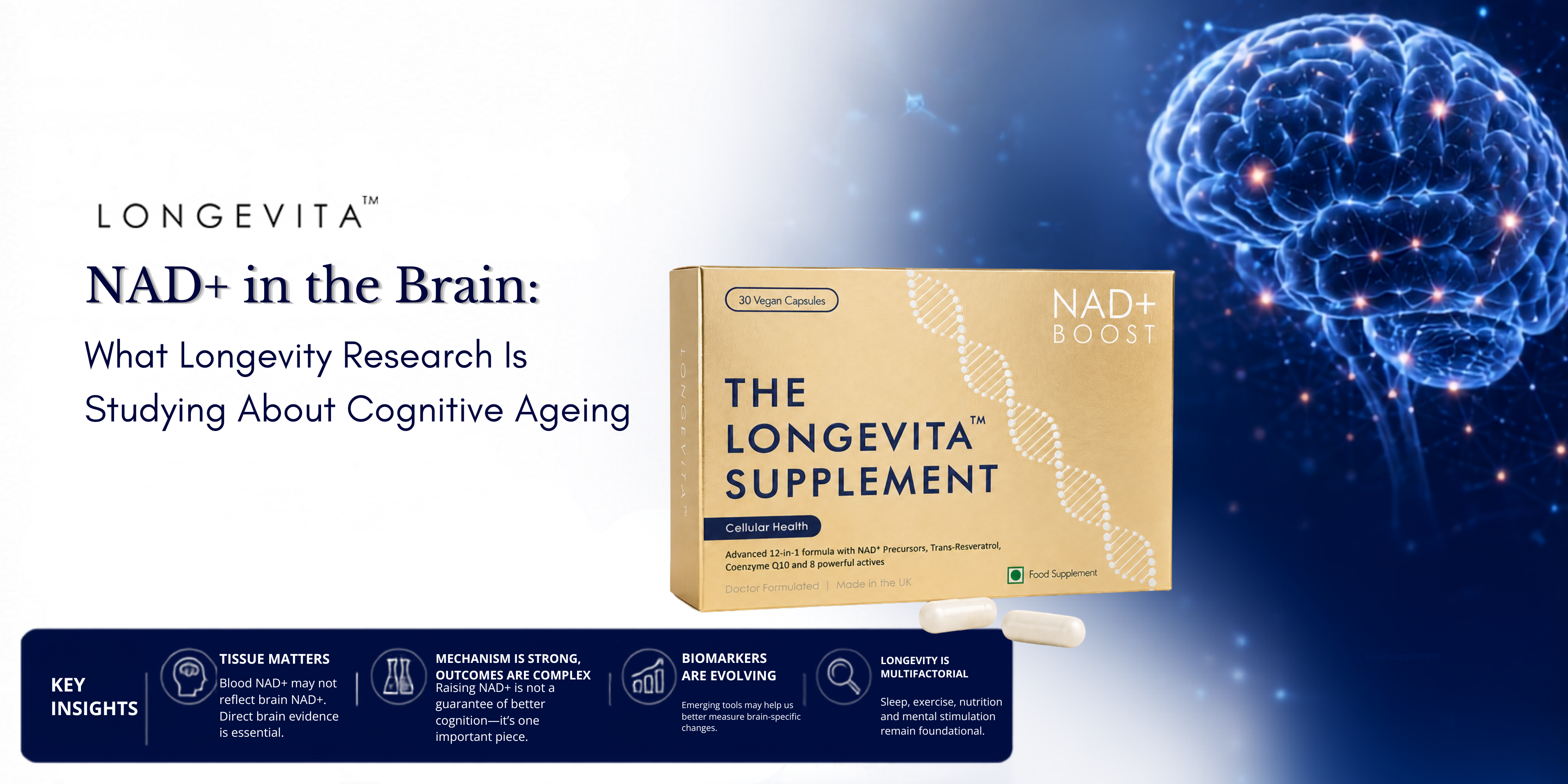
NAD+ in the Brain: What Longevity Research Is Studying About Cognitive Ageing
Of all the organs in the body, the brain may have the least tolerance for an energy shortfall. It represents roughly two per cent of body weight but consumes around twenty per cent of the body's total energy output, almost entirely through mitochondrial metabolism (Ahmadi Rastegar et al., 2024).
This extraordinary energy demand is precisely why nicotinamide adenine dinucleotide, commonly known as NAD+, has become one of the most closely studied molecules in the science of cognitive ageing. NAD+ sits at the centre of the brain's energy metabolism, and researchers are increasingly investigating how its age-related decline may relate to neurodegeneration and cognitive change (Ahmadi Rastegar et al., 2024).
Why Does the Brain Depend So Heavily on NAD+?
Neurons are among the most metabolically demanding cells in the body. Unlike many other cell types, they have limited capacity to store energy and rely almost continuously on mitochondrial ATP production to maintain synaptic activity, neurotransmission and cellular repair (Ahmadi Rastegar et al., 2024).
NAD+ is essential to this process, functioning as a critical electron carrier in mitochondrial respiration. Beyond energy metabolism, NAD+ also fuels sirtuins, proteins involved in regulating cellular stress responses and genomic stability, and PARPs, enzymes responsible for repairing DNA damage, both of which are active within brain tissue (Sun, Wang, Xu & Zhao, 2025).
Because the brain depends so heavily on a continuous, well-regulated NAD+ supply, even modest disruptions to NAD+ metabolism can have outsized effects on neuronal function compared to less energy-intensive tissues.
Does Brain NAD+ Decline with Age?
Direct evidence in humans comes from non-invasive brain imaging. Using magnetic resonance spectroscopy (MRS), researchers have measured NAD+ concentrations and the NAD+/NADH ratio directly in the living human brain, and found a clear, measurable, age-related decline across the lifespan (Zhu et al., 2015).
This tissue-level evidence is significant because it demonstrates that brain NAD+ decline is not merely inferred from animal studies or peripheral blood markers, but has been directly observed in vivo in humans. Researchers studying brain metabolic plasticity note that this decline reflects an imbalanced relationship between NAD+ production and consumption, driven by factors including reduced NAD+ biosynthesis and excessive activity of NAD+-degrading enzymes under conditions of oxidative stress (Ahmadi Rastegar et al., 2024).
How Is NAD+ Decline Linked to Neurodegeneration?
Researchers have proposed that declining NAD+ availability contributes to several processes implicated in age-related cognitive decline and neurodegenerative disease, including impaired mitochondrial function, reduced capacity for DNA repair and diminished cellular resilience to oxidative stress (Ahmadi Rastegar et al., 2024).
This is thought to matter particularly for neurons, which have limited regenerative capacity compared to many other cell types. When NAD+-dependent DNA repair and antioxidant defence systems become less effective, accumulating cellular damage may progressively impair neuronal function over time, a process researchers believe unfolds gradually over years or decades rather than as a sudden event.
Recent preclinical research has begun to identify more specific mechanisms. A 2025 study using mouse and worm models of tau-related neurodegeneration, a hallmark feature of Alzheimer's disease, found that boosting NAD+ helped correct altered expression of a gene called EVA1C, which appears to influence axonal development and cognitive resilience. In tau-model worms, restoring NAD+ improved memory-like performance and extended lifespan by nearly seventeen per cent, though this benefit depended on the presence of a functioning EVA1C gene, suggesting NAD+'s cognitive effects may work through specific, identifiable molecular pathways rather than a generalised energy boost alone.
Separately, researchers investigating brain energy metabolism in Alzheimer's models have found that restoring the brain's energy balance may not only slow disease progression but could potentially help reverse aspects of memory impairment, reinforcing the connection between brain bioenergetics and cognitive outcomes.
What Do Human Clinical Trials Show?
Preclinical findings are compelling, but human trial results remain genuinely mixed, an important distinction for anyone evaluating claims about NAD+ and brain health.
A Phase 2A, double-blind, randomised, placebo-controlled trial of nicotinamide, an NAD+ precursor, in people with early Alzheimer's disease found a nominally significant effect on cognitive decline, but this result did not survive correction for multiple statistical comparisons, meaning it cannot yet be considered a confirmed benefit (Grill et al., 2024).
A separate crossover, double-blind, placebo-controlled trial examined eight weeks of nicotinamide riboside supplementation at 1 gram per day in older adults with subjective cognitive decline and mild cognitive impairment, assessing both cognitive performance and plasma Alzheimer's biomarkers (Wu et al., 2025).
Other research has taken a biomarker-focused approach. One study found that oral nicotinamide riboside supplementation raised NAD+ levels and reduced certain biomarkers of neurodegenerative pathology measured in plasma extracellular vesicles enriched for neuronal origin, offering a potential window into brain-relevant biological change even without directly measuring cognition (Vreones et al., 2022).
Several larger and more targeted trials are now underway, including studies using advanced techniques such as ³¹P magnetic resonance spectroscopy to directly measure whether NAD+ precursors succeed in raising NAD+ levels within the brain itself, and dose-finding studies in Alzheimer's patients assessing cognitive performance alongside markers of autophagy and inflammation.
Why the Mixed Results Matter
The gap between promising preclinical findings and inconclusive human trials reflects a broader pattern in NAD+ research, one worth understanding rather than dismissing.
Raising peripheral or even brain NAD+ levels does not automatically guarantee a measurable cognitive benefit within the relatively short timeframes of most clinical trials to date. Neurodegenerative processes typically develop over decades, and reversing or meaningfully slowing established cognitive decline may require sustained intervention, higher brain-penetrant doses, or combination approaches that address oxidative stress and inflammation alongside NAD+ metabolism (Grill et al., 2024).
This is why current research increasingly focuses on refining dosing, treatment duration and precise brain-based outcome measures, rather than treating NAD+ precursors as a standalone solution for cognitive ageing.
Supporting Healthy Cognitive Ageing
While NAD+ metabolism is an important piece of the brain-ageing picture, cognitive health is influenced by many interacting factors, including cardiovascular health, sleep quality, chronic inflammation and oxidative stress.
Regular exercise, quality sleep, cardiovascular health management, cognitive engagement and social connection all play well-established roles in supporting long-term brain health.
Supplements may provide additional support, but they work best as part of a broader, multi-pathway approach to cellular and cognitive health, rather than being relied upon in isolation.
How Longevita™ Supports Brain-Relevant Cellular Pathways
The research summarised here points to a consistent theme: supporting brain health at the cellular level requires addressing NAD+ metabolism, mitochondrial function and oxidative stress together, since neurons are uniquely sensitive to disruptions across all three systems.
This is the scientific rationale behind The Longevita™ Supplement, a doctor-formulated, 12-ingredient longevity formula designed to target the key hallmarks of ageing by promoting cellular energy, helping manage senescent cell burden, and strengthening antioxidant and inflammation defence systems.
At its core, Longevita™ combines Nicotinamide Riboside Chloride, which boosts NAD⁺ levels to activate sirtuins and enhance DNA repair, with Nicotinamide, which sustains NAD⁺ pools for mitochondrial energy and antioxidant defence, both feeding the same salvage pathway studied in the Alzheimer's and cognitive decline trials referenced above. Alongside these precursors, Coenzyme Q10 preserves mitochondrial ATP production and reduces oxidative stress, directly relevant given the brain's outsized dependence on mitochondrial energy output, while Calcium Alpha Ketoglutarate enhances mitochondrial energy and reduces inflammaging via epigenetic modulation.
To further support the brain's antioxidant defences, Longevita™ includes Trans-Resveratrol, which activates SIRT1 for mitochondrial function while promoting autophagy and DNA repair, and Pterostilbene, a highly bioavailable analogue that activates SIRT1/AMPK pathways to enhance mitochondrial biogenesis. The formula also includes L-Theanine, an amino acid studied for supporting focus and calm mental clarity, alongside Ginseng, which activates antioxidant pathways and promotes autophagy via SIRT1 and FOXO signalling, and Fisetin, which supports the clearance of senescent cells linked to chronic inflammation. Piperine upregulates antioxidant enzymes and enhances mitochondrial biogenesis via PGC-1α, supporting the absorption and utility of these co-ingredients, while Lutein and Hyaluronic Acid extend the formula's support to visual health and skin.
Formulated by a doctor and longevity specialist, and manufactured in a GMP-certified, USFDA-registered facility with third-party testing for potency and contaminants, Longevita™ is built on the premise that supporting cognitive and cellular resilience requires addressing NAD+ synthesis, mitochondrial function and oxidative stress together, not any single pathway in isolation.
The Bottom Line
The brain's exceptional dependence on mitochondrial energy makes it particularly sensitive to age-related NAD+ decline, which has been directly observed in living human brain tissue through imaging studies. While preclinical research continues to uncover promising mechanisms linking NAD+ to neuroprotection and memory function, human clinical trials in Alzheimer's disease and cognitive decline have so far produced genuinely mixed results, with some studies showing encouraging signals that require further confirmation.
This nuance matters. Understanding both the strength of the underlying biology and the current limits of clinical evidence offers a more honest picture of where NAD+ and brain health research currently stands, and reinforces the value of a comprehensive, multi-pathway approach to supporting cellular and cognitive health as we age.
Explore The Longevita™ Supplement, a doctor-formulated, 12-ingredient longevity formula designed to support NAD+ status, mitochondrial function and cellular resilience as part of a daily routine.
FAQs
-
Does NAD+ decline in the brain with age?
Yes. Non-invasive brain imaging studies using magnetic resonance spectroscopy have directly measured a clear, age-related decline in brain NAD+ levels and the NAD+/NADH ratio in living humans.
-
Can NAD+ supplements improve cognitive function?
The evidence is currently mixed. Some trials in Alzheimer's disease and mild cognitive impairment have shown promising but statistically inconclusive results, while others have found NAD+ precursors reduce certain biomarkers of neurodegeneration without yet confirming direct cognitive improvement.
-
Why does the brain need so much NAD+?
The brain consumes around twenty per cent of the body's total energy despite representing about two per cent of body weight, relying almost entirely on mitochondrial metabolism, which depends on a continuous, well-regulated NAD+ supply.
-
Are there ongoing clinical trials studying NAD+ and brain health?
Yes. Several trials are currently investigating NAD+ precursors in Alzheimer's disease and mild cognitive impairment, using advanced brain imaging techniques to directly measure whether supplementation successfully raises NAD+ within brain tissue itself.
References
Ahmadi Rastegar, D. et al. (2024) 'Pathobiochemistry of ageing and neurodegeneration: deregulation of NAD+ metabolism in brain cells', Biomolecules, 14(12), 1556.
Grill, J.D., Tam, S., Thai, G., Vides, B., Pierce, A.L., Green, K., Gillen, D.L., Teng, E., Kremen, S., Beigi, M., Rissman, R.A., Léger, G.C., Balasubramanian, A., Revta, C., Morrison, R., Jennings, R., Pa, J., Zhang, J., Jin, S. & Feldman, H.H. (2024) 'Phase 2A proof-of-concept double-blind, randomized, placebo-controlled trial of nicotinamide in early Alzheimer disease', Neurology, 104(1), e210152.
Sun, J.Y., Wang, Z.F., Xu, W.H. & Zhao, J. (2025) 'NAD+ glycohydrolases-CD38 as a therapeutic target in ageing: physiological roles, molecular mechanisms, and future opportunities in anti-ageing research', Biochemical and Biophysical Research Communications, in press.
Vreones, M., Mustapic, M., Moaddel, R., Pucha, K.A., Lovett, J., Seals, D.R., Kapogiannis, D. & Martens, C.R. (2022) 'Oral nicotinamide riboside raises NAD+ and lowers biomarkers of neurodegenerative pathology in plasma extracellular vesicles enriched for neuronal origin', Ageing Cell, 22(1), e13754.
Wu, C., Kupferschmid, A.C., Chen, L., McManus, A.J., Kivisäkk, P., Galler, J.A., Schwab, N.A., DesRuisseaux, L.A., Williams, V.J., Gerber, J., Riley, M., Young, C., Guzmán-Vélez, E. & Dodge, H.H. (2025) 'Cognitive and Alzheimer's disease biomarker effects of oral nicotinamide riboside (NR) supplementation in older adults with subjective cognitive decline and mild cognitive impairment', Alzheimer's & Dementia: Translational Research & Clinical Interventions, 11(1), e70023.
Zhu, X.H., Lu, M., Lee, B.Y., Ugurbil, K. & Chen, W. (2015) 'In vivo NAD assay reveals the intracellular NAD contents and redox state in healthy human brain and their age dependences', Proceedings of the National Academy of Sciences, 112(9), pp. 2876–2881.