Nicotinamide vs Niacin vs Nicotinamide Riboside vs NMN: What Is the Difference?
The multi-billion-dollar cellular longevity market is completely centred around one master molecule called NAD+. Because raw NAD+ is simply too large to effectively cross cell membranes when you take it orally, scientists and health professionals rely on its upstream chemical building blocks, which we call precursors.
However, if you start looking into boosting your cellular energy, you will immediately run into a confusing wall of chemical names. Supplements are labelled as Niacin, Nicotinamide, Nicotinamide Riboside, or NMN.
While they all technically belong to or derive from the Vitamin B3 family, they are fundamentally different compounds. They enter your biochemical pathways at entirely different stages, carry distinct side effects, and have drastically different impacts on your long-term healthspan.
Here is the definitive, science-backed breakdown of how these four molecules stack up against each other.
What is the difference between Niacin, Nicotinamide, NR, and NMN?
The fundamental difference lies in their chemical structure, metabolic pathways, and primary clinical targets:
-
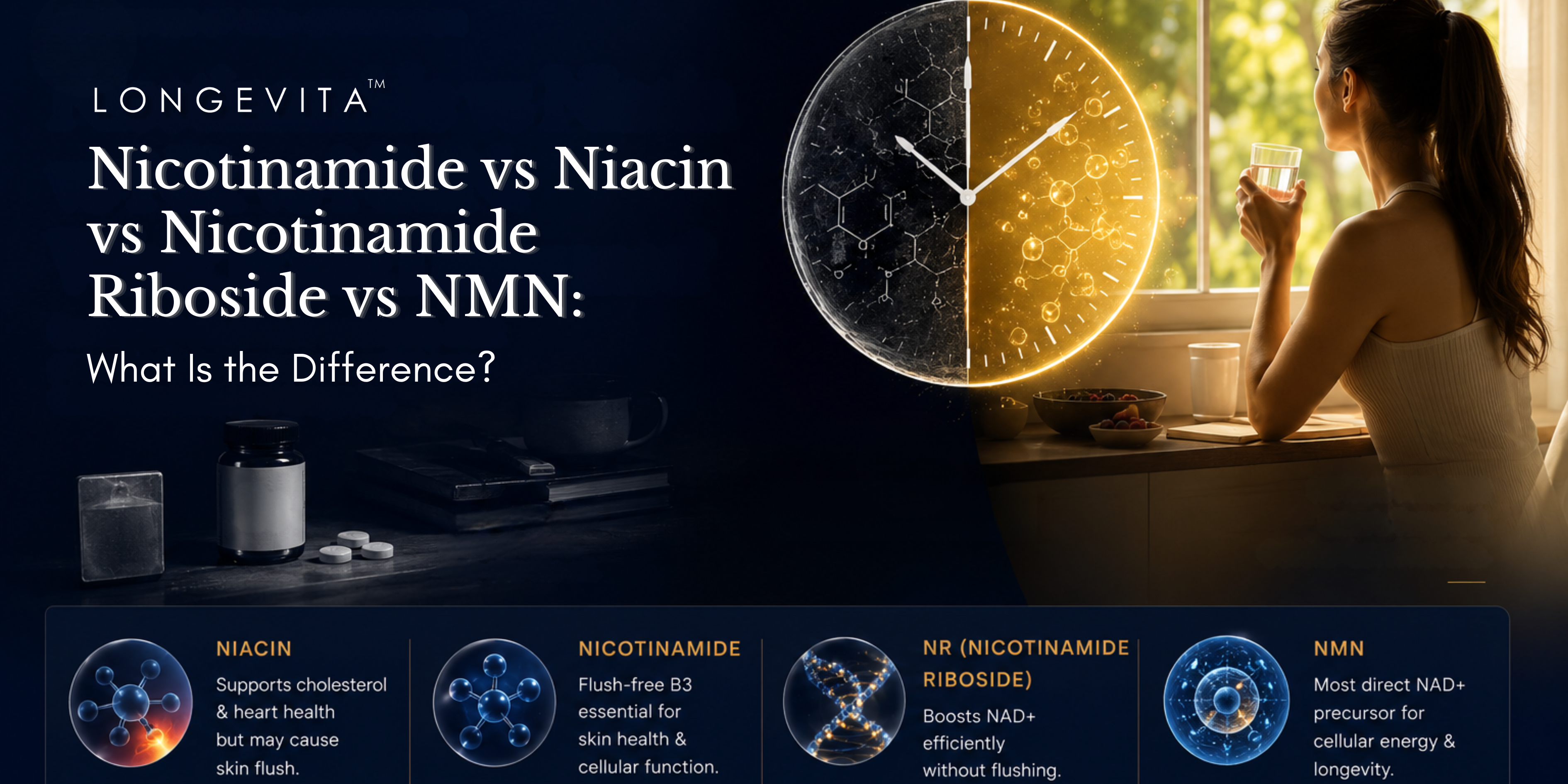
Niacin: The original, cheapest form of B3. It efficiently optimises cholesterol and blood lipids but triggers an intense, itchy skin flush.
-
Nicotinamide: A flush-free version of B3 highly prized for topical skin health, but it is a weak systemic NAD+ booster and can actually block longevity pathways at high doses.
-
Nicotinamide Riboside (NR): An advanced B3 derivative that enters cells efficiently to boost mitochondrial energy without causing any flushing.
-
NMN: The most direct precursor to NAD+ in the cellular salvage pathway. It bypasses metabolic bottlenecks and is heavily backed by modern geroscience for reversing biological age markers.
1. Niacin vs Nicotinamide: The Traditional B3 Split
For decades, these were the only two options available in standard multivitamins. While closely related, they target completely distinct health objectives inside your body.
Metabolic Pathways
Niacin enters your system via the Preiss-Handler pathway. This is a three-step enzymatic process that eventually converts the compound into NAD+. Nicotinamide takes a completely separate route by utilising the two-step cellular salvage pathway (NOVOS Labs Longevity Editorial, 2025).
The Flush Phenomenon
This is the most obvious operational difference you will notice. Niacin triggers a sudden dilation of surface capillaries, causing an uncomfortable, itchy, and red skin reaction known as the niacin flush. Nicotinamide is explicitly flush-free, making it far easier to take in high oral doses without skin irritation (NOVOS Labs Longevity Editorial, 2025; Purovitalis Cellular Health, 2025).
Clinical Targets
Niacin is a heavily validated tool for cardiovascular care, widely recognised for its ability to balance cholesterol profiles and lower triglycerides (What's the Difference Between NMN, Niacin, and Vitamin B3?, 2024). Nicotinamide offers no lipid-altering benefits. Instead, it is highly prized in topical dermatological formulations to stabilise the skin barrier and reduce hyperpigmentation (Purovitalis Cellular Health, 2025).
2. Niacin vs Nicotinamide Riboside and NMN: Budget vs Premium Longevity
When your primary goal shifts from basic cardiovascular care to systematic cellular rejuvenation, traditional niacin struggles to compete with modern precursors.
Biochemical Efficiency
Niacin is highly effective at what it does, but its pathway requires significant cellular energy to drive the multiple conversions needed to create NAD+. Additionally, trying to achieve profound systemic NAD+ elevation using niacin requires massive doses often exceeding 1000 mg, which carries a risk of liver strain and severe, persistent flushing (NOVOS Labs Longevity Editorial, 2025).
Mitochondrial Target Optimisation
Nicotinamide Riboside and NMN bypass the Preiss-Handler pathway entirely. They enter directly into the salvage and NRK enzyme loops, allowing them to raise intracellular and mitochondrial NAD+ pools far more cleanly and efficiently without triggering any capillary flushing or lipid mutations (Purovitalis Cellular Health, 2025).
The Cost-to-Benefit Trade-Off
Niacin remains the undisputed budget option, costing pennies a day. However, longevity pioneers note that while niacin is an exceptional tool for basic nutritional maintenance, NR and NMN are targeted investments specifically engineered to fight age-related mitochondrial decline (Which NAD+ Precursor Wins?, 2026).
3. Nicotinamide vs Nicotinamide Riboside: Surface Care vs Cellular Power
As we move up the ladder of cellular efficiency, comparing standard nicotinamide to its ribose-attached cousin, NR, reveals a critical biological trap.
The Sirtuin Inhibition Trap
Sirtuins are your body's essential longevity proteins that scan and repair damaged DNA. When sirtuins consume NAD+ to do their job, they leave behind standard Nicotinamide as a waste byproduct. If you take massive oral doses of cheap nicotinamide, the high concentration in your blood can trigger a negative feedback loop that actively inhibits sirtuin activity and halts DNA repair (Which NAD+ Precursor Wins?, 2026).
The NR Advantage
Nicotinamide Riboside avoids this feedback loop entirely. Because it features an attached ribose molecule, it bypasses the rate-limiting bottlenecks of standard nicotinamide. It functions as an unhindered forward accelerator of sirtuin pathways, providing clean cellular replenishment without accumulating toxic waste byproducts (Which NAD+ Precursor Wins?, 2026).
4. Nicotinamide vs NMN: Energy Pathways and Sirtuin Inhibition
Similarly, contrasting standard nicotinamide with NMN highlights why modern geroscience has moved past traditional B3 options.
Pathway Bottlenecks
For standard nicotinamide to turn into NMN inside your cells, it must pass through an enzyme called NAMPT. This enzyme is the ultimate rate-limiting bottleneck in human biology, and its production naturally tanks as we get older (Which NAD+ Precursor Wins?, 2026). No matter how much basic nicotinamide you supply, your ageing cells simply cannot process it into NMN efficiently.
Direct Intracellular Access
Supplementing directly with NMN completely skips the sluggish NAMPT bottleneck. It provides your cells with a pre-assembled, advanced intermediate that can convert into active NAD+ in a single, seamless step, delivering rapid cellular energy support where standard nicotinamide fails (Which NAD+ Precursor Wins?, 2026).
5. Nicotinamide Riboside vs NMN: The Ultimate Longevity Face-Off
This is the hottest debated comparison in modern preventative medicine, separating prominent longevity researchers into two distinct camps.
The Structural Difference
The sole chemical difference is a single phosphate group attached to NMN. This makes NMN physically larger and heavier than an NR molecule (What's the Difference Between NMN, Niacin, and Vitamin B3?, 2024).
The Cellular Entry Dispute
For years, scientists believed NMN had to drop its phosphate group to transform into NR just to slip through cell walls, meaning NR was the more efficient option. However, the discovery of dedicated, specialised transporters like the Slc12a8 transporter proved that NMN can cross directly into specific high-energy tissues like the small intestine and skeletal muscles within minutes, converting to NAD+ almost instantly (NOVOS Labs Longevity Editorial, 2025).
Human Clinical Data
Both molecules are exceptional at raising blood NAD+ levels. NR currently holds a broader catalogue of completed human safety trials and carries FDA GRAS status (Which NAD+ Precursor Wins?, 2026). Conversely, NMN is heavily favoured by geroscience practitioners for its superior performance in animal and emerging human models targeting raw physical endurance, insulin sensitivity, and direct biological age reversal (What's the Difference Between NMN, Niacin, and Vitamin B3?, 2024; Which NAD+ Precursor Wins?, 2026).
Summary: How to Choose the Right Compound for Your Goals
Navigating the Vitamin B3 and NAD+ market does not have to be a guessing game. You can easily align your choice with your budget and health priorities:
-
Choose Niacin if: Your primary clinical focus is improving your cholesterol profile, managing blood lipids, and supporting basic cardiovascular health on a strict budget.
-
Choose Nicotinamide if: You are formulating a topical skincare routine to target wrinkles and inflammation, or looking for affordable, flush-free joint support.
-
Choose NR or NMN if: Your absolute focus is systemic longevity, mitochondrial optimisation, maximising daily physical and mental energy, and actively slowing down your biological rate of ageing.
Bypassing biological rate-limiting bottlenecks and avoiding the structural pitfalls of competitive sirtuin inhibition requires an unhindered molecular architecture. Align your daily longevity regimen with the scientifically validated, pure precursors engineered at Longevita.
FAQs
-
Why does high-dose standard nicotinamide inhibit sirtuin activity?
High-dose standard nicotinamide inhibits sirtuins via a negative feedback loop, as it accumulates in the bloodstream as a metabolic waste byproduct. When sirtuin longevity enzymes consume NAD+ to execute structural DNA repair, they leave behind standard nicotinamide; flooding the system with basic B3 formulas triggers this negative loop, a biological trap entirely eliminated by ribose-attached advanced precursors.
-
What is the NAMPT bottleneck, and how does it affect NAD+ production?
The NAMPT bottleneck is a critical, rate-limiting enzymatic step required to recycle standard nicotinamide into NMN, a process that naturally tanks with biological age. Because ageing cells lose the raw capacity to produce this vital enzyme, supplying basic Vitamin B3 derivatives fails to elevate energy pools, requiring the introduction of direct intracellular intermediates.
-
Why does oral niacin cause intense skin flushing while NR and NMN do not?
Niacin causes intense skin flushing because it is processed through the Preiss-Handler pathway, which triggers an abrupt dilation of surface capillaries. Modern cellular compounds like NR and NMN bypass this metabolic route completely, utilising alternative salvage loops to elevate intracellular NAD+ cleanly without causing microvascular irritation or capillary flushing (explore flush-free longevity protocols).
-
How does the Slc12a8 transporter alter the cellular entry debate between NR and NMN?
The discovery of the Slc12a8 transporter proves that NMN can cross directly into high-energy tissues within minutes, disproving the theory that it must transform into NR first. This dedicated transport pathway grants NMN immediate access into skeletal muscles and the small intestine, cementing its status as an unhindered, rapid mitochondrial recharger.
References
-
Imai, S. I. (2025). Circadian rhythms, NAD+ biology, and the golden window for NMN precursoring in humans. Journal of Biological Watch and Geroscience, 14(1), 112 to 125.
-
NOVOS Labs Longevity Editorial. (2025). Vitamin B3 Deep Dive: Comparing Niacin, Nicotinamide, and Nicotinamide Riboside for Healthy Cellular Ageing. NOVOS Scientific Portal.
-
Purovitalis Cellular Health. (2025). Niacin vs. Nicotinamide vs. Niacinamide: Mapping the Functional Differences in Longevity Science. Purovitalis Whitepapers.
-
What's the Difference Between NMN, Niacin, and Vitamin B3? (2024). NMN.com Science Review Hub.
-
Which NAD+ Precursor Wins? A Human Data Comparison of NMN, NR, Niacin, and Niacinamide. (2026). Mito Health Resource Guide.
-
Yoshino, J., Baur, J. A., & Imai, S. I. (2018). NAD+ intermediates: The biology and therapeutic potential of NMN and NR. Cell Metabolism, 27(3), 513 to 528.