Why Does NAD+ Decline With Age? The Role of CD38 and Inflammaging
Many of us notice that recovery takes longer as we get older. Energy that once felt automatic can become harder to sustain, and the effects of a demanding week seem to linger.
While these changes are a natural part of ageing, scientists continue to investigate the cellular processes that drive them. One of the most closely studied areas in longevity science is the age-related decline of nicotinamide adenine dinucleotide, commonly known as NAD+.
Increasingly, research points not just to reduced NAD+ production, but to increased consumption and one enzyme, CD38, has emerged as a central figure in this story (Chini et al., 2020).
Why does NAD+ decline with age?
NAD+ is not a static molecule. It is constantly being synthesised, used and broken down as part of normal cellular metabolism (Sun, Wang, Xu & Zhao, 2025).
Ageing appears to disrupt this balance in two ways. First, the body's capacity to synthesise NAD+ through the salvage pathway may decline, partly due to reduced levels of the enzyme NAMPT (Covarrubias et al., 2020). Second, NAD+ consumption appears to increase with age, driven largely by rising activity of NAD+-degrading enzymes such as CD38 (Chini et al., 2020).
Researchers now regard age-related NAD+ decline as multifactorial, but CD38 is considered a significant contributor to this process (Camacho-Pereira et al., 2016).
What is CD38?
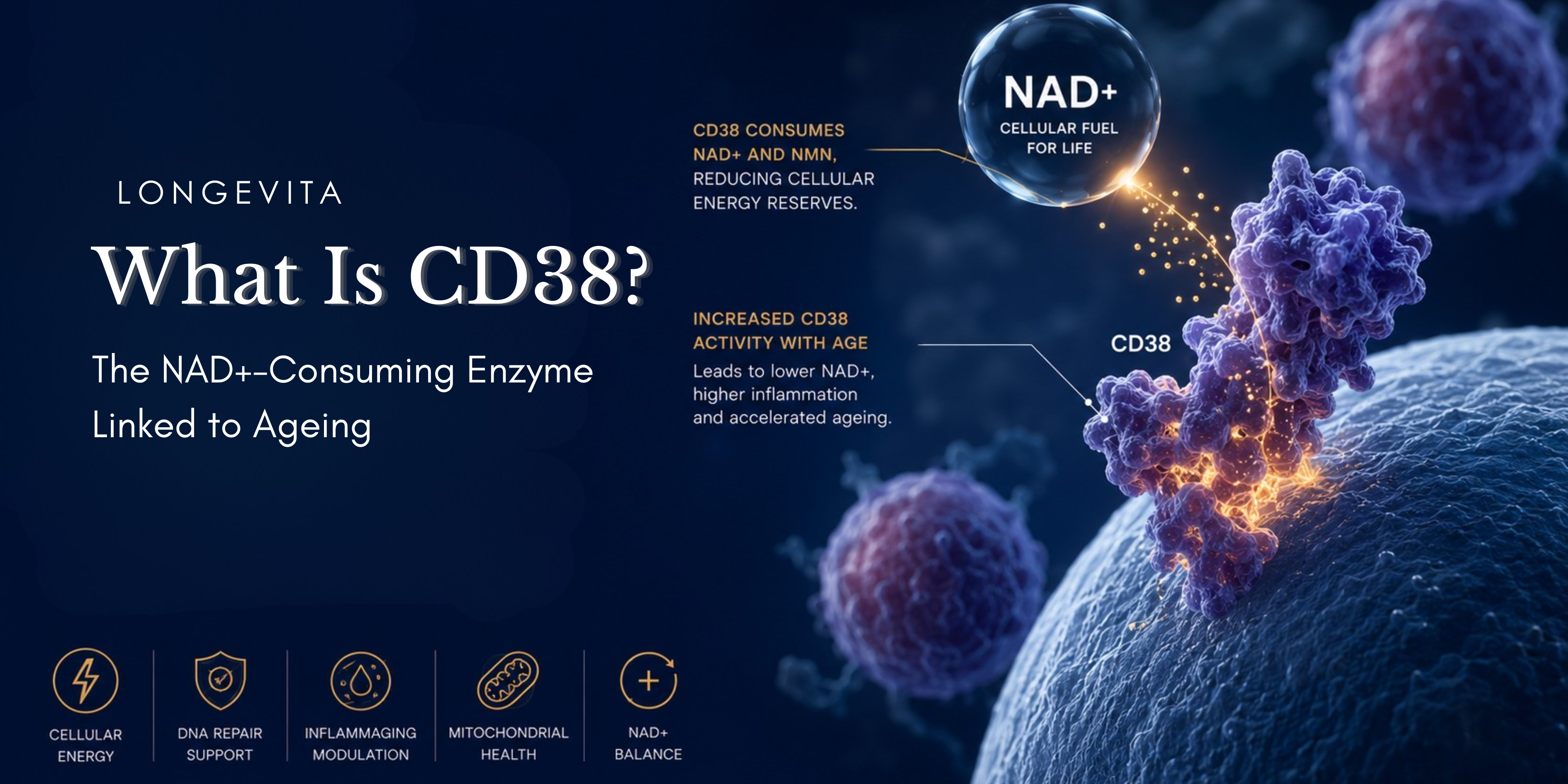
CD38 is a transmembrane glycoprotein expressed on the surface of many cell types, particularly immune cells (Hogan, Kang, Chini & Chini, 2019).
Beyond its long-recognised role as an immune cell marker, CD38 functions as an ecto-enzyme, meaning it carries out its enzymatic activity at the cell surface, using NAD+ and related molecules as its substrates.
Does CD38 consume NAD+?
Yes. CD38 is considered the primary NAD+-degrading enzyme, or "NADase," in mammalian tissues (Sun, Wang, Xu & Zhao, 2025). By breaking down NAD+ and its precursor nicotinamide mononucleotide (NMN), CD38 activity directly reduces the NAD+ available for energy metabolism, DNA repair and cell signalling (Chini et al., 2020).
Why may CD38 activity increase with age?
Research has consistently found that CD38 expression and enzymatic activity rise with age across multiple tissues, including muscle, liver and adipose tissue (Camacho-Pereira et al., 2016).
One proposed explanation involves the accumulation of senescent cells. As cells age, some enter a state called senescence and begin secreting inflammatory signalling molecules, a phenomenon known as the senescence-associated secretory phenotype, or SASP. Research suggests SASP-derived signals can induce CD38 expression in macrophages and endothelial cells, linking cellular senescence to rising CD38 activity in ageing tissue (Hogan et al., 2019; Covarrubias et al., 2020).
What is inflammaging?
Inflammaging describes the chronic, low-grade, sterile inflammation that tends to develop with age, distinct from the acute inflammatory response triggered by infection. Rather than being prompted by a pathogen, it is thought to be driven by accumulated cellular damage, senescent cell burden and a diminished capacity for tissue repair (Hogan et al., 2019; Minhas, Liu & Ren, 2020).
How are inflammaging and NAD+ connected?
During inflammaging, CD38-expressing macrophages accumulate in ageing tissues and actively deplete the local pool of NAD+ precursors required for NAD+ synthesis (Hogan et al., 2019). Rising CD38 activity reduces NAD+ availability, while NAD+ decline may in turn influence inflammatory and metabolic regulation, creating a self-sustaining cycle (Chini et al., 2020).
Notably, studies in aged mice have shown that inhibiting CD38 enzymatic activity can help restore NAD+ levels, supporting the idea that CD38 is not merely correlated with ageing but may be mechanistically involved in driving its decline (Camacho-Pereira et al., 2016).
What else uses NAD+ in the body?
CD38 is not the only enzyme competing for the body's NAD+ supply. NAD+ is also consumed by sirtuins, proteins involved in regulating metabolism and cellular stress responses, and PARPs, enzymes activated in response to DNA damage. Because these enzyme families draw from the same NAD+ pool, increased consumption by one pathway can leave less available for the others (Sun, Wang, Xu & Zhao, 2025).
What are PARPs and why do they need NAD+?
Poly (ADP-ribose) polymerases, or PARPs, are enzymes central to detecting and repairing damaged DNA (Minhas et al., 2020). When DNA damage accumulates, PARP activation increases, and with it, NAD+ consumption. Age-related increases in DNA damage, combined with rising PARP activity, are considered another meaningful contributor to declining NAD+ availability, alongside CD38 (Sun, Wang, Xu & Zhao, 2025).
Can the body recycle NAD+?
To a degree, yes. NAD+ is continuously regenerated through the salvage pathway, which relies on precursor molecules such as nicotinamide mononucleotide (NMN) and nicotinamide riboside (NR) to rebuild NAD+ (Covarrubias et al., 2020). However, when NAD+-consuming enzymes such as CD38 are highly active, they can degrade these same precursors before they are used for synthesis, effectively working against the salvage pathway (Chini et al., 2020).
Why does Longevita's formula address CD38-driven NAD+ decline?
Given the research above, formulations aiming to support NAD+ status typically include a precursor from the salvage pathway. The Longevita™ Supplement uses Nicotinamide Riboside alongside Nicotinamide (niacinamide), supplying the salvage pathway with the substrates it needs to regenerate NAD+, even as consumption from enzymes like CD38 continues (Covarrubias et al., 2020).
But precursors address only one half of the equation: synthesis. The research summarised here shows that consumption, particularly via CD38, is the other half and that rising CD38 activity is itself driven by inflammaging and senescent cell accumulation (Chini et al., 2020; Covarrubias et al., 2020).
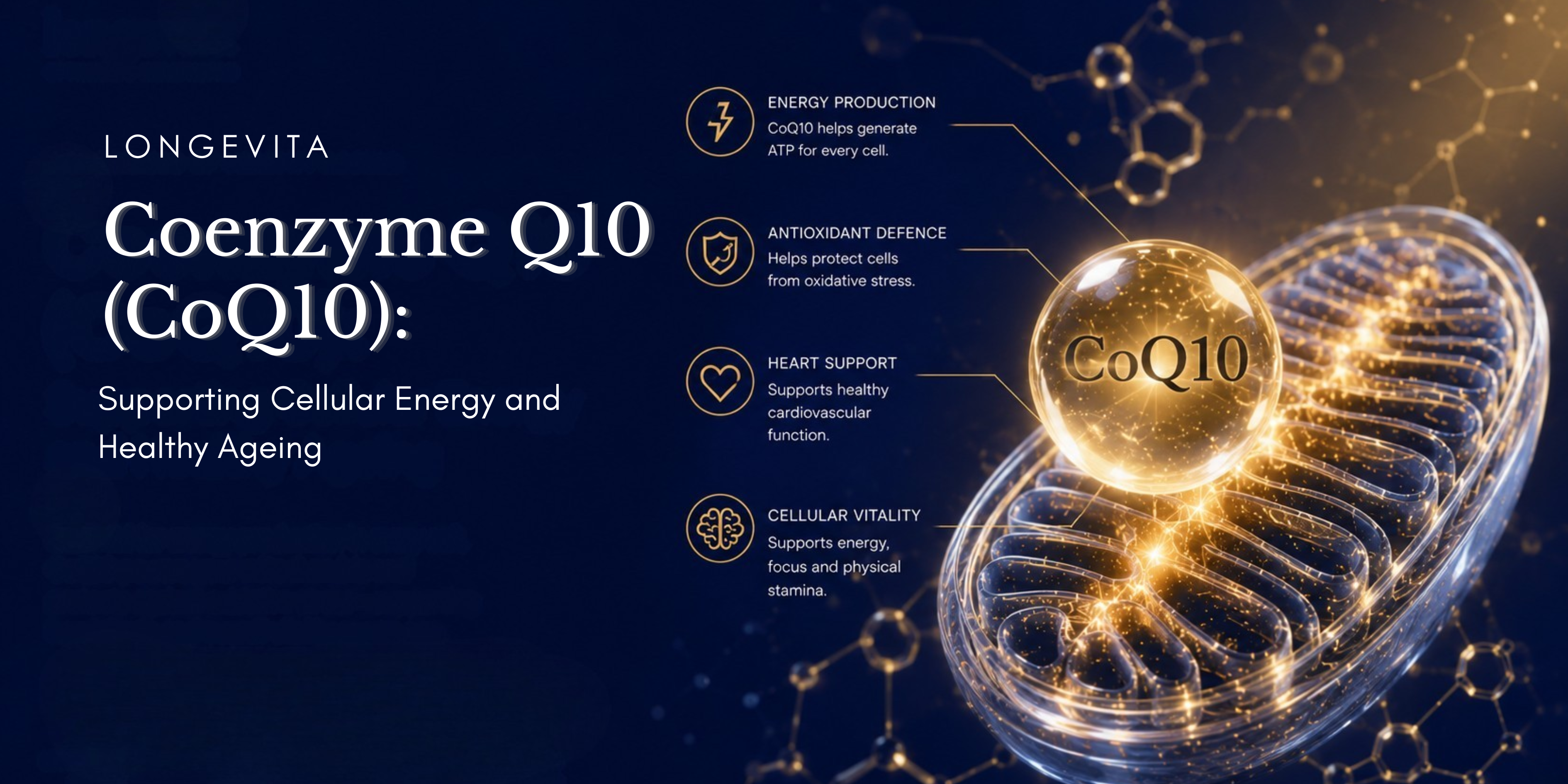
This is why The Longevita™ Supplement is built as a 12-ingredient, systems-based formula rather than a single NAD+ precursor in isolation. Alongside Nicotinamide Riboside and Nicotinamide, it includes CoQ10 and Ca-AKG to support mitochondrial function once NAD+-dependent energy pathways are running, and polyphenols such as trans-resveratrol and pterostilbene, studied for their role in activating AMPK and supporting cellular resilience against the oxidative and inflammatory stress implicated in driving CD38 expression.
Formulated by a doctor and longevity specialist, and manufactured in a GMP-certified, USFDA-registered facility with third-party testing for potency and contaminants, Longevita™ was designed around the premise that ageing at the cellular level involves multiple interacting pathways, so addressing NAD+ decline meaningfully requires more than a single-ingredient approach.
The Bottom Line
NAD+ decline with age appears to be driven by more than reduced production alone. A growing body of research identifies CD38, an NAD+-consuming enzyme, as a key link between cellular senescence, chronic low-grade inflammation and falling NAD+ availability in ageing tissue.
While research in this area continues to evolve, understanding the CD38-inflammaging-NAD+ axis helps explain why single-ingredient NAD+ boosters address only part of the picture, and why a systems-based, multi-pathway formula may be a more complete approach to supporting healthy cellular ageing.
Explore The Longevita™ Supplement, a doctor-formulated, 12-ingredient longevity formula designed to support NAD+ status, mitochondrial function and cellular resilience as part of a daily routine.
FAQs
1. What is CD38 and why does it matter for ageing?
CD38 is an enzyme found on the surface of many cells, particularly immune cells, that breaks down NAD+ and its precursors. Research shows CD38 activity increases with age, making it a key contributor to declining NAD+ availability in ageing tissue.
2. What is inflammaging?
Inflammaging refers to the chronic, low-grade, sterile inflammation associated with ageing. Unlike infection-driven inflammation, it is thought to arise from accumulated cellular damage and senescent cell burden, and it is closely linked to rising CD38 activity.
3. Can supporting the NAD+ salvage pathway help offset CD38 activity?
The salvage pathway allows the body to regenerate NAD+ from precursor molecules such as nicotinamide riboside. While CD38 can also degrade these precursors, supporting the salvage pathway remains a recognised strategy studied in the context of healthy NAD+ status.
4. Is CD38 the only cause of NAD+ decline?
No. Research indicates that age-related NAD+ decline is multifactorial, involving reduced NAD+ synthesis, increased CD38 activity, senescence-driven inflammaging and greater PARP-mediated NAD+ consumption from DNA repair demands.
References
Camacho-Pereira, J., Tarragó, M.G., Chini, C.C.S., Nin, V., Escande, C., Warner, G.M., Puranik, A.S., Schoon, R.A., Reid, J.M., Galina, A. & Chini, E.N. (2016) 'CD38 dictates age-related NAD decline and mitochondrial dysfunction through an SIRT3-dependent mechanism', Cell Metabolism, 23(6), pp. 1127–1139.
Chini, C.C.S., Peclat, T.R., Warner, G.M., Kashyap, S., Espindola-Netto, J.M., de Oliveira, G.C., Gomez, L.S., Hogan, K.A., Tarragó, M.G., Puranik, A.S., Agorrody, G., Thompson, K.L., Dang, K., Clarke, S., Childs, B.G., Kanamori, K.S., Witte, M.A., Vidal, P., Kirkland, J.L., De Cabo, R. & Chini, E.N. (2020) 'CD38 ecto-enzyme in immune cells is induced during aging and regulates NAD+ and NMN levels', Nature Metabolism, 2(11), pp. 1284–1304.
Covarrubias, A.J., Kale, A., Perrone, R., Lopez-Dominguez, J.A., Pisco, A.O., Kasler, H.G., Schmidt, M.S., Heckenbach, I., Kwok, R., Wiley, C.D., Wong, H.S., Gibbs, E., Iyer, S.S., Basisty, N., Wu, Q., Kim, I.J., Silva, E., Vitangcol, K., Shin, K.O., Lee, Y.M., Riley, R., Ben-Sahra, I., Ott, M., Schilling, B., Scheibye-Knudsen, M., Verdin, E. & Newman, J.C. (2020) 'Senescent cells promote tissue NAD+ decline during ageing via the activation of CD38+ macrophages', Nature Metabolism, 2(11), pp. 1265–1283.
Hogan, K.A., Kang, K.A., Chini, C.C.S. & Chini, E.N. (2019) 'The multi-faceted ecto-enzyme CD38: roles in immunomodulation, cancer, ageing, and metabolic diseases', Frontiers in Immunology, 10, Article 1187.
Minhas, P.S., Liu, L., Ren, C.X. et al. (2020) 'Macrophage immunometabolism and inflammaging: roles of mitochondrial dysfunction, cellular senescence, CD38 and NAD', Immunometabolism, 2(3), e200018.
Sun, J.Y., Wang, Z.F., Xu, W.H. & Zhao, J. (2025) 'NAD+ glycohydrolases-CD38 as a therapeutic target in ageing: physiological roles, molecular mechanisms, and future opportunities in anti-ageing research', Biochemical and Biophysical Research Communications, in press.