

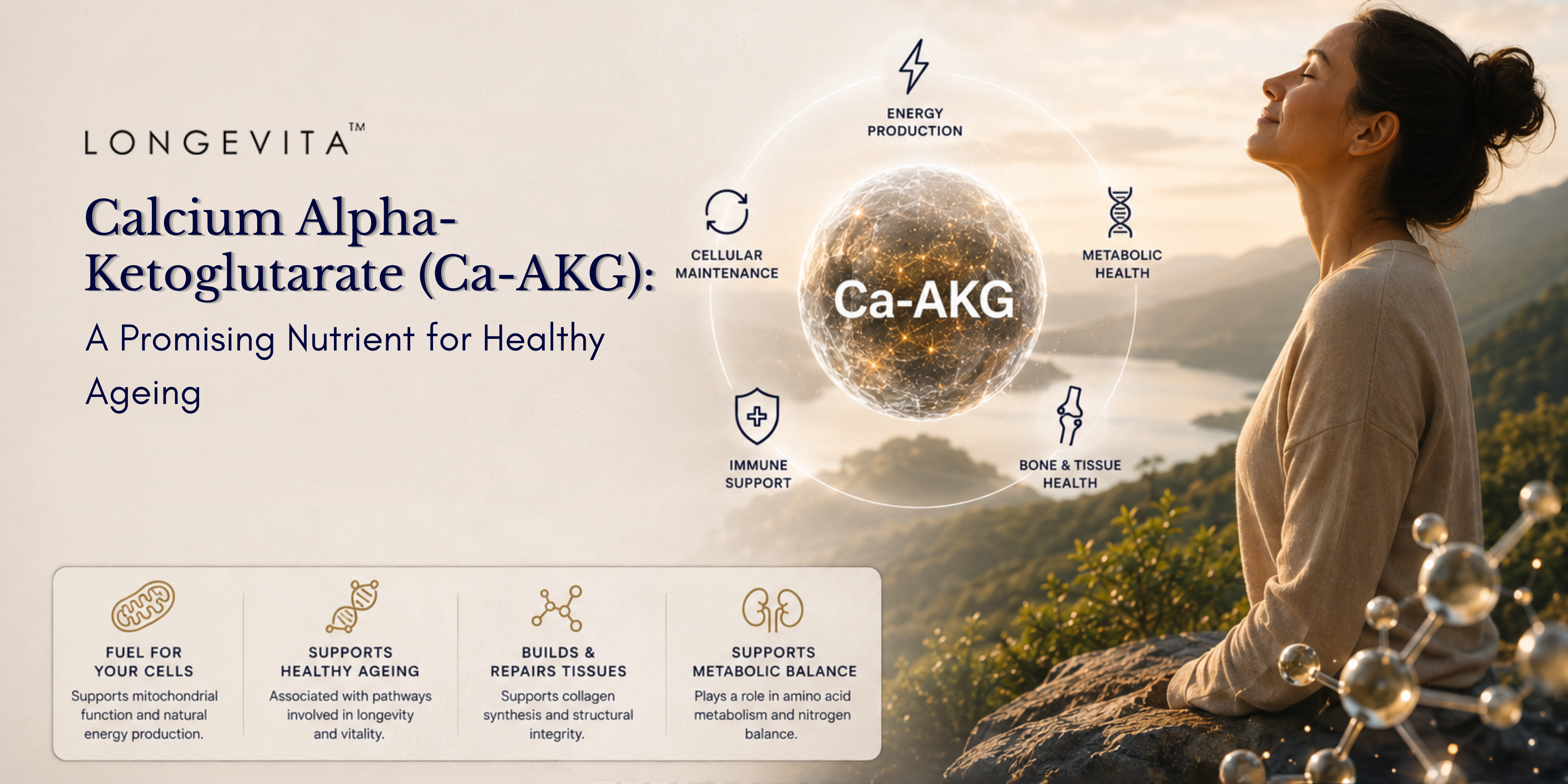
Calcium Alpha-Ketoglutarate (Ca-AKG): A Promising Nutrient for Healthy Ageing
When scientists study longevity, they often focus on compounds that the body naturally produces rather than entirely new discoveries.
One such compound is alpha-ketoglutarate (AKG), a molecule that plays an essential role in how our cells produce energy, build important proteins and maintain normal metabolic function. Although most people have never heard of it, AKG is involved in some of the body's most fundamental biological processes.
Research has shown that natural levels of AKG decline significantly with age, leading scientists to investigate whether restoring those levels may help support healthy ageing and long-term healthspan (Gyanwali, Lim & Kennedy, 2022).
Today, Calcium Alpha-Ketoglutarate (Ca-AKG) has become an increasingly studied compound within longevity science. While research is still evolving, early findings suggest it may influence several biological pathways associated with energy metabolism, tissue maintenance and cellular health.
So, what exactly is Ca-AKG, and why has it attracted so much attention in healthy ageing research?
What is Calcium Alpha-Ketoglutarate?
Alpha-ketoglutarate (AKG) is a naturally occurring molecule involved in the Krebs cycle, also known as the citric acid cycle. This process takes place inside our cells and helps convert nutrients from food into usable energy (Gyanwali, Lim & Kennedy, 2022).
Think of the Krebs cycle as one of the body's energy-producing systems. AKG acts as an important intermediate within this process, helping cells generate the energy needed for normal function.
In supplement form, AKG is often combined with calcium to create Calcium Alpha-Ketoglutarate (Ca-AKG), a stable form that can be more easily delivered and absorbed by the body.
Beyond its role in energy production, AKG is also involved in amino acid metabolism, collagen synthesis and cellular signalling pathways associated with healthy ageing (Gyanwali, Lim & Kennedy, 2022).
Is Calcium Alpha-Ketoglutarate the Same as Calcium?
A common question is whether Ca-AKG is simply another form of calcium.
The answer is no.
Traditional calcium supplements are primarily used to support bone health and help maintain adequate calcium intake.
Ca-AKG serves a different purpose. While it contains calcium, its primary function is to deliver alpha-ketoglutarate, the biologically active compound being studied for its role in metabolism, cellular maintenance and healthy ageing.
The calcium component helps stabilise the molecule and supports its delivery within the body.
Why Does AKG Matter as We Age?
Research suggests that natural AKG levels decline significantly with age (Gyanwali, Lim & Kennedy, 2022).
Because AKG is involved in multiple metabolic pathways, this decline has led researchers to investigate whether restoring healthy levels may help support some aspects of age-related physiological change.
Scientists are particularly interested in AKG because it appears to influence several biological processes associated with healthy ageing, including cellular energy production, inflammation, tissue maintenance and metabolic regulation.
While research is ongoing, these findings have made AKG one of the more widely discussed compounds in the field of longevity science.
Ca-AKG and Cellular Energy
Every cell in the body relies on a continuous supply of energy.
As part of the Krebs cycle, AKG helps facilitate the conversion of carbohydrates, fats and proteins into energy that cells can use for growth, repair and normal function (Gyanwali, Lim & Kennedy, 2022).
Because energy production naturally becomes less efficient with age, maintaining healthy mitochondrial function remains an important area of longevity research.
Scientists continue to explore whether AKG supplementation may help support these processes throughout life.
Supporting Healthy Ageing
One of the reasons AKG has attracted attention is its potential influence on several biological pathways associated with ageing.
Research suggests that AKG may help regulate inflammation, support cellular maintenance mechanisms and influence metabolic pathways involved in longevity (Gyanwali, Lim & Kennedy, 2022).
In recent years, researchers have also explored its effects on biological ageing markers.
A small human study reported improvements in measures of biological age following Ca-AKG supplementation, although larger and longer-term studies are needed before firm conclusions can be drawn (Miller, 2026).
These early findings are encouraging, but further research is required to better understand the long-term effects in diverse populations.
Ca-AKG and Cellular Maintenance
Healthy ageing depends on the body's ability to maintain and repair tissues over time.
Researchers have investigated whether AKG may influence cellular housekeeping processes, including pathways involved in the removal and recycling of damaged cellular components (Harrison, 2024).
These mechanisms help cells maintain normal function and are increasingly recognised as important contributors to long-term healthspan.
Although research is still developing, this remains one of the most promising areas of AKG science.
Bone and Connective Tissue Health
AKG also plays a role in amino acid metabolism and collagen production.
Collagen is the most abundant structural protein in the body and is essential for maintaining healthy skin, connective tissues and bone structure.
Research suggests that AKG may support collagen synthesis and contribute to maintaining healthy bone metabolism, particularly as we age (Vance, 2023).
Scientists continue to investigate how these effects may contribute to healthy ageing and physical resilience.
Kidney Health and Nitrogen Balance
Another area of interest is AKG's role in nitrogen metabolism.
AKG participates in processes that help manage nitrogen balance within the body and contributes to the formation of amino acids such as glutamine (Gyanwali, Lim & Kennedy, 2022).
Because of these functions, researchers have explored its potential role in supporting metabolic health and certain aspects of kidney function.
However, individuals with existing kidney conditions or those taking medications affecting mineral balance should consult a healthcare professional before beginning supplementation.
Is Ca-AKG Safe?
Current evidence suggests that Ca-AKG is generally well tolerated.
Reported side effects are typically mild and may include temporary digestive discomfort in some individuals, particularly when higher amounts are consumed (Keller, 2025).
As with any supplement, it is important to follow recommended dosage guidelines and seek medical advice if you have existing health conditions or are taking prescription medications.
The Bigger Picture
While Ca-AKG is an exciting area of longevity research, no single supplement can determine how well we age.
Healthy ageing is built upon a foundation of regular exercise, quality sleep, balanced nutrition, stress management and meaningful social connections.
Supplements may provide additional support, but they work best when combined with healthy lifestyle habits that support long-term wellbeing.
The Bottom Line
Calcium Alpha-Ketoglutarate is a naturally occurring compound involved in cellular energy production, metabolism and tissue maintenance.
As levels decline with age, researchers are increasingly investigating its potential role in supporting healthy ageing and healthspan.
While much of the research is still emerging, early findings suggest that Ca-AKG may influence several biological pathways associated with longevity. Combined with a healthy lifestyle, it represents an intriguing area of ongoing scientific exploration.
Restoring the critical metabolic intermediates lost to biological attrition requires verified molecular stability. Access the high-purity, clinical-grade cellular compounds engineered at Longevita.
FAQs
-
What is the primary role of Alpha-Ketoglutarate (AKG) in the human body?
Alpha-ketoglutarate acts as an essential intermediate in the Krebs cycle, facilitating the conversion of dietary nutrients into usable cellular energy. Beyond directly fueling mitochondrial ATP production, this naturally occurring metabolite coordinates vital amino acid pathways and collagen synthesis, which is why pure stabilised formulations are heavily utilised in modern longevity science.
-
How does Calcium Alpha-Ketoglutarate (Ca-AKG) differ from standard calcium supplements?
While traditional calcium supplements solely address structural bone density, Ca-AKG uses calcium exclusively to stabilise and deliver the active alpha-ketoglutarate molecule. This precise molecular pairing ensures optimal absorption into the bloodstream, bypassing delivery bottlenecks to actively target cellular signalling networks and support systemic healthspan expansion.
-
Can supplementing with Ca-AKG influence a person's biological age?
Emerging clinical data suggests that Ca-AKG supplementation can positively modify measures of biological age by supporting cellular housekeeping and tissue maintenance. By regulating low-grade systemic inflammation and promoting the recycling of damaged cellular components, these advanced compounds help align your functional physical capacity with evidence-based biological metrics.
-
Why does natural alpha-ketoglutarate production decline as we grow older?
The age-related drop in natural AKG levels is driven by a combination of escalating cellular stress and a progressive slowdown in internal metabolic recycling loops. This depletion creates a widespread cellular energy deficit that leaves tissues vulnerable to degradation, an issue that can be countered via targeted mitochondrial nutrient intervention.
References
Gyanwali, B., Lim, X.Y. & Kennedy, B.K. (2022) 'Alpha-ketoglutarate: An essential metabolite coordinating ageing pathways and healthspan expansion', Trends in Endocrinology and Metabolism, 33(12), pp. 814–829.
Harrison, J. (2024) A Comprehensive Guide to Understanding Calcium AKG, Autophagy and Cellular Signalling. ProHealth Academic Press.
Keller, F. (2025) Calcium Alpha-Ketoglutarate (Ca-AKG): Therapeutic Potential, Renal Function and Safety Profile in Chronic Hemodialysis Patients. Qidosha Research Review.
Miller, T. (2026) Calcium Alpha-Ketoglutarate (Ca-AKG): Can It Safely Reduce Our Biological Age? Neotes Clinical Research Hub.
Vance, L. (2023) The Benefits of Calcium AKG: Boosting Bone, Liver and Brain Function Through the Krebs Cycle. Xandro Longevity Journal, 2(4), pp. 12–19.

,%20a%20molecule%20that...)