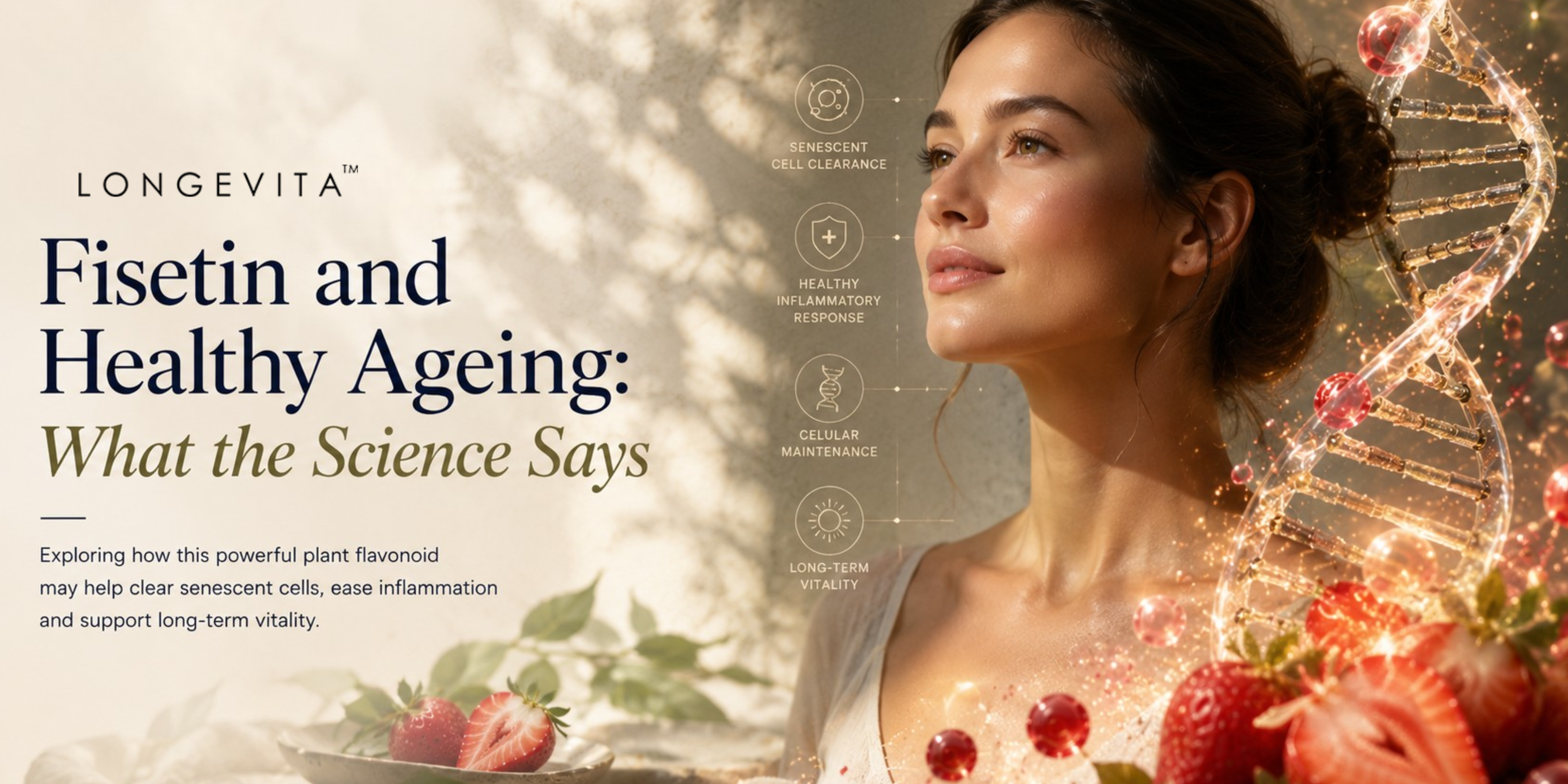
Fisetin and Healthy Ageing: What the Science Says
As we grow older, changes occur throughout the body that can affect how we feel, move and function. While ageing is a natural process, scientists are increasingly interested in understanding the biological mechanisms that influence healthy ageing and long-term healthspan.
One area attracting growing attention is cellular senescence. This process occurs when damaged or stressed cells stop dividing but remain within tissues. Over time, the accumulation of these cells may contribute to age-related changes in cellular function and increased levels of inflammation (Kirkland & Tchkonia, 2020).
Researchers are now investigating compounds that may help support the body's ability to manage these ageing-related processes. One of the most studied is a naturally occurring plant compound called fisetin.
What is Fisetin?
Fisetin is a flavonoid, a type of naturally occurring plant compound found in a variety of fruits and vegetables. It is present in foods such as strawberries, apples, grapes, onions and cucumbers, with strawberries containing some of the highest naturally occurring concentrations (Maher, 2021).
Like many plant polyphenols, fisetin acts as more than a dietary nutrient. Researchers have found that it interacts with multiple cellular pathways involved in inflammation, stress resistance and cellular maintenance (Maher, 2021).
This has led to growing interest in its potential role in supporting healthy ageing.
Cellular Senescence and Healthy Ageing
To understand why fisetin has attracted attention, it helps to understand cellular senescence.
Throughout life, cells are exposed to various forms of stress, including DNA damage, oxidative stress and environmental factors. In response, some cells enter a state known as senescence. These cells remain alive but no longer function normally.
Scientists believe that the accumulation of senescent cells may contribute to chronic, low-grade inflammation and age-related decline in tissue function (Kirkland & Tchkonia, 2020).
Because of this, researchers have been exploring compounds known as senolytics. These compounds are being studied for their ability to help the body remove or manage senescent cells more effectively.
Fisetin is one of the most widely researched natural compounds within this area of longevity science.
Potential Benefits of Fisetin
While research is still evolving, several potential areas of interest have emerged.
Supporting Cellular Health
Laboratory and animal studies suggest that fisetin may influence pathways involved in cellular maintenance and resilience. Researchers have observed effects on mechanisms associated with oxidative stress, inflammation and cellular survival (Youcef, 2023).
These findings have contributed to growing interest in fisetin as a potential healthy ageing compound.
Supporting Healthy Inflammatory Responses
Ageing is often accompanied by a gradual increase in low-grade inflammation, sometimes referred to as "inflammageing".
Research suggests that fisetin may help regulate inflammatory signalling pathways, including NF-kB, which plays an important role in the body's inflammatory response (Maher, 2021).
Maintaining healthy inflammatory balance is considered an important component of long-term health and vitality.
Brain Health and Cognitive Function
The brain is particularly vulnerable to oxidative stress and inflammation.
Early research suggests that fisetin may help support neuronal health and protect against certain age-related changes in cognitive function. Scientists are continuing to investigate its potential role in supporting memory, learning and overall brain health (Maher, 2021).
However, more human studies are needed to fully understand these effects.
Cellular Maintenance Pathways
Researchers have also explored fisetin's interaction with several pathways associated with healthy ageing, including mTOR and sirtuins (Kirkland & Tchkonia, 2020).
These pathways help regulate how cells respond to stress, repair damage, and maintain normal function throughout life.
Why Bioavailability Matters?
One challenge with fisetin supplementation is bioavailability.
Fisetin is poorly soluble in water, which can limit how much is absorbed by the body when consumed in traditional supplement forms (Stevens, 2024).
For this reason, researchers and manufacturers have explored delivery systems designed to improve absorption.
Liposomal Fisetin
Liposomal technology surrounds active ingredients with microscopic lipid structures that may help improve absorption and stability within the digestive system (Youcef, 2023).
Fisetin-Galactomannan Complexes
Another approach combines fisetin with galactomannans, naturally occurring fibres derived from fenugreek. Early studies suggest this may help improve absorption and prolong circulation within the body (Stevens, 2024).
Research in this area continues to develop, and further human studies will help clarify the effectiveness of different delivery methods.
Is Fisetin Safe?
Current research suggests that fisetin is generally well tolerated.
Reported side effects are typically mild and may include temporary digestive discomfort in some individuals, particularly when larger amounts are consumed (Pratt, 2025).
As with any supplement, individuals taking prescription medications or managing existing health conditions should consult a qualified healthcare professional before beginning supplementation.
This is particularly important for people taking blood-thinning medications or treatments that affect blood glucose regulation (Pratt, 2025).
The Bigger Picture
While fisetin is an exciting area of longevity research, it is important to remember that no single supplement determines how well we age.
Healthy ageing is built upon a foundation of regular physical activity, quality sleep, good nutrition, stress management and strong social connections.
Supplements may play a supportive role, but they work best as part of a broader healthy ageing strategy.
The Bottom Line
Fisetin is a naturally occurring plant compound that has emerged as one of the most studied flavonoids in longevity research.
Scientists are investigating its potential role in supporting cellular health, healthy inflammatory responses and the management of cellular senescence. While much of the research remains in its early stages, the findings so far are encouraging.
As our understanding of healthy ageing continues to evolve, compounds such as fisetin may provide valuable insights into how we can support vitality, resilience and long-term healthspan throughout life.
Mitigating the progressive accumulation of senescent cells and resolving the systemic bioavailability paradox requires precise macromolecular engineering. Align your long-term healthspan strategy with the high-absorption, clinically validated senolytic protocols developed at Longevita.
FAQs
-
What is a senolytic compound and how does fisetin function as one?
Senolytic compounds are targeted agents studied for their ability to help the body systematically clear out dysfunctional, non-dividing senescent cells. As a potent natural flavonoid, fisetin modulates critical intracellular pathways to support the clearance of this microscopic debris, restoring tissue resilience through highly targeted senolytic protocols.
-
Why is standard raw fisetin considered to have low biological availability?
Standard raw fisetin suffers from low bioavailability because it is poorly soluble in water, which severely restricts its initial absorption through the digestive tract. To circumvent this metabolic barrier, modern longevity science utilises advanced lipid encapsulation or fibre-binding technologies to ensure maximum systemic delivery into the bloodstream.
-
How does fisetin help regulate chronic low-grade inflammageing?
Fisetin helps regulate inflammageing by directly modulating critical inflammatory signalling pathways, most notably the NF-kB protein complex. By downregulating the hyperactivation of these molecular switches, it mitigates the continuous secretion of inflammatory compounds from ageing tissues.
-
What is the scientific advantage of a fisetin-galactomannan complex?
A fisetin-galactomannan complex pairs the active flavonoid with natural fenugreek fibres to significantly prolong its systemic circulation and elevate absorption. This specialised delivery system shields the fragile plant polyphenol from premature breakdown in the gut, allowing it to interact effectively with target cellular repair networks.
References
Kirkland, J.L. & Tchkonia, T. (2020) 'Senolytic drugs: from discovery to translation', Journal of Internal Medicine, 288(5), pp. 518–536.
Maher, P. (2021) 'Fisetin acts on multiple pathways to reduce the impact of age and disease on CNS function', Frontiers in Bioscience, 26(2), pp. 422–433.
Pratt, H. (2025) Polyphenols and Longevity: A Clinical Safety and Tolerability Review of High-Dose Fisetin Therapeutics. Mayo Research Briefs.
Stevens, R. (2024) 'Flavonoid Bioavailability Paradox: Comparing Galactomannan Complexes and Standard Botanical Extracts', Vanguard Nutrition Journal, 11(3), pp. 142–151.
Youcef, M. (2023) 'Fisetin protects cellular networks from oxidative damage by inhibiting senescent accumulations', Open Exploration of Longevity Therapeutics, 5(1), pp. 19–33.