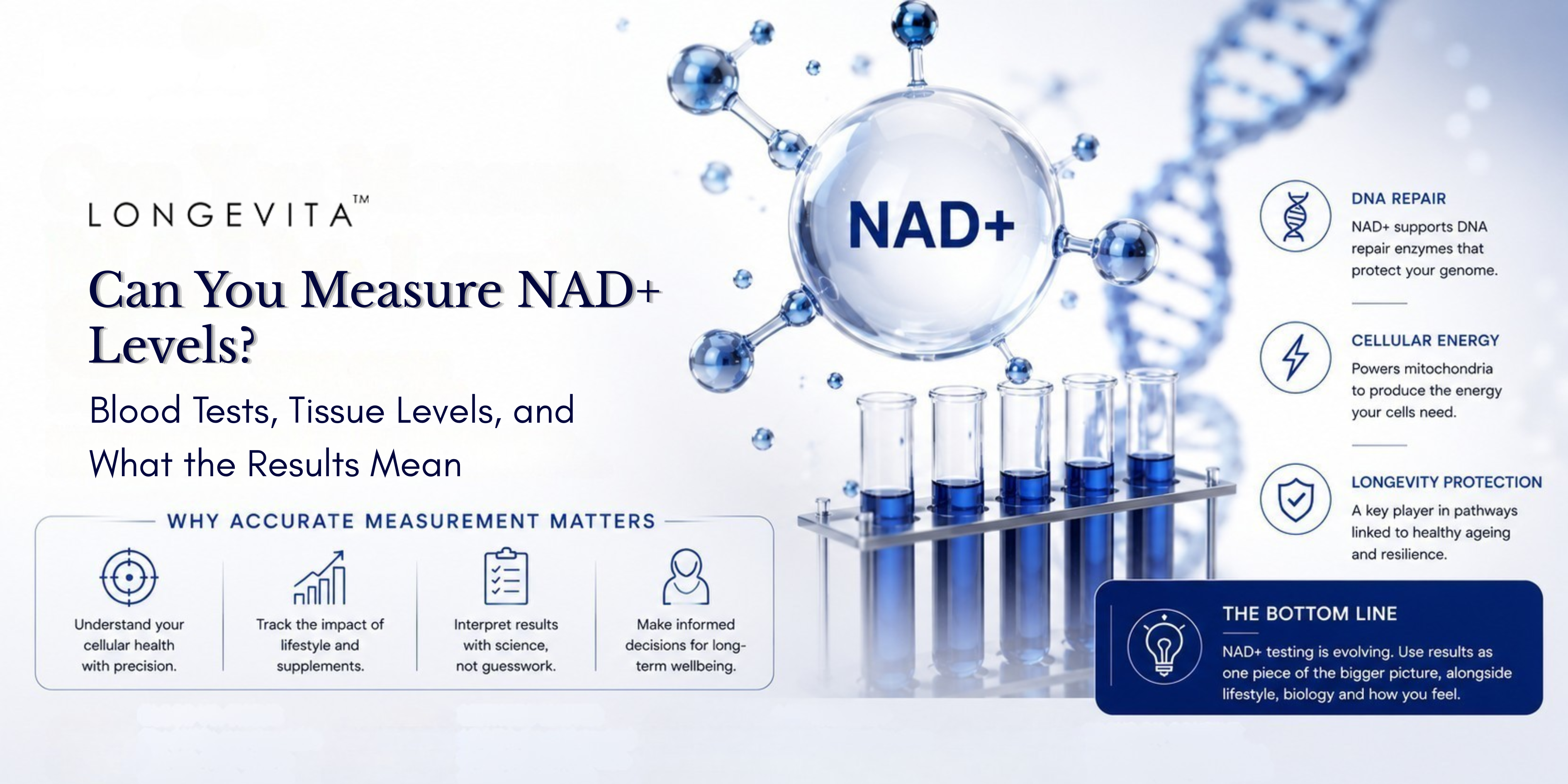
Can You Measure NAD+ Levels? Blood Tests, Tissue Levels and What the Results Mean
Type "NAD+ test" into any search engine and you'll find dozens of at-home kits promising to reveal your cellular age with a single finger-prick. It's an appealing idea: a number that tells you exactly how your ageing is progressing, and whether your supplement routine is working.
The reality, as with most areas of longevity science, is more complicated. Nicotinamide adenine dinucleotide, commonly known as NAD+, is notoriously difficult to measure accurately, and a growing body of research suggests that where you measure it matters just as much as how (Trętowicz et al., 2026).
Understanding what current NAD+ testing can and cannot tell you is essential before drawing conclusions from any single result.
Why Is NAD+ Difficult to Measure?
NAD+ is a chemically unstable molecule that degrades rapidly once a blood sample is drawn, and it exists across different compartments within the body, including blood, plasma, red blood cells and individual tissues, each of which can show different concentrations (NADFAQ, 2026).
Unlike a standard cholesterol or vitamin D panel, there is currently no single FDA-cleared clinical assay for NAD+. Research laboratories generally rely on validated methods such as liquid chromatography-mass spectrometry (LC-MS), while a growing number of consumer-facing companies offer simplified assays with varying degrees of analytical rigour (NADFAQ, 2026).
This matters because the methodology behind a test result is often more informative than the number itself.
What Methods Are Used to Measure NAD+?
Several distinct approaches exist, each with different strengths and limitations.
Liquid chromatography-mass spectrometry (LC-MS) is widely regarded as the gold-standard research method. It offers high accuracy and can simultaneously quantify NAD+ alongside related metabolites such as NMN, NR and nicotinamide, but it requires specialised laboratory equipment and careful sample handling immediately after collection (Yoshino & Imai, 2013).
Enzymatic cycling assays are more affordable and widely used in commercial and academic labs. They are accessible but generally less precise than LC-MS, particularly at very low NAD+ concentrations.
Dried blood spot and finger-prick tests, including newer bioluminescence resonance energy transfer (BRET)-based methods, have made testing more convenient by requiring only a few microlitres of capillary blood. Recent validation work suggests these methods can correlate closely with venous blood samples, though results can still vary depending on handling and storage conditions (Goldman Laboratories, 2026).
Regardless of method, correct sample handling is critical. Because NAD+ degrades quickly, samples that are not properly quenched or stored can produce misleadingly low readings, an issue increasingly recognised as a major source of variability across different studies and testing companies (Trętowicz et al., 2026).
Does Blood NAD+ Actually Decline with Age?
This is where the science has become genuinely more complex in recent months.
For years, it was widely assumed that falling blood NAD+ was a reliable marker of ageing. However, a large 2026 study published in Nature Metabolism, using rigorously validated mass spectrometry across seven independent human cohorts and hundreds of participants, found that whole-blood NAD+ levels remained remarkably stable with age and were largely unaffected by lifestyle interventions such as exercise or diet, though levels did rise in response to nicotinamide riboside supplementation, as expected (Trętowicz et al., 2026).
This finding challenges the long-standing assumption that a simple blood draw can reliably indicate NAD+-related ageing, and has prompted researchers to look more carefully at the difference between circulating blood NAD+ and NAD+ status within specific organs and tissues.
So Does NAD+ Decline with Age at All?
Yes, but the evidence for this comes primarily from tissue-level studies rather than whole blood.
Skin. In a frequently cited study, Massudi and colleagues measured NAD+ directly in human pelvic skin biopsies spanning from newborn to 77 years of age, and found a clear, progressive, age-related decline alongside increasing markers of oxidative stress (Massudi et al., 2012).
Skeletal muscle. Direct muscle biopsy studies have found that NAD+ levels are measurably lower in older adults compared to younger adults, with the difference being more pronounced in physically impaired older adults than in those who remained athletic (de Guia et al., 2019).
Brain. Non-invasive magnetic resonance spectroscopy (MRS) studies have documented age-related declines in brain NAD+ and the NAD+/NADH ratio, providing direct in vivo evidence of tissue-level change (Zhu et al., 2015).
Taken together, this body of evidence suggests that while circulating whole-blood NAD+ may remain relatively stable, tissue-specific NAD+ pools, particularly in skin, muscle and brain, do appear to decline with age. Researchers increasingly caution that whole blood may be an imperfect proxy for what is actually happening inside organs and tissues (Trętowicz et al., 2026).
What Drives This Tissue-Level Decline?
Tissue-level NAD+ decline is generally attributed to two interacting mechanisms explored elsewhere in longevity research: reduced synthesis via the salvage pathway, partly due to falling NAMPT levels, and increased consumption by NAD+-degrading enzymes such as CD38 and PARPs (Camacho-Pereira et al., 2016; Chini et al., 2020).
Because CD38 activity and PARP activation both rise with age in specific tissues, largely in response to chronic low-grade inflammation and accumulating DNA damage, the decline observed in skin, muscle and brain reflects a genuinely local, tissue-specific process, rather than a single global number that a blood test could easily capture.
What Should You Take Away From a NAD+ Test?
Given this complexity, a single NAD+ blood test result should be interpreted cautiously rather than treated as a definitive marker of biological age.
A normal or stable blood NAD+ reading does not necessarily rule out lower NAD+ status in specific tissues such as skin, muscle or brain. Equally, a rise in blood NAD+ following supplementation, which multiple studies confirm does occur with nicotinamide riboside and related precursors, is a meaningful and measurable physiological response, even if it does not, on its own, capture what is happening throughout the body (Trętowicz et al., 2026).
For most people, tracking general trends alongside how they feel, energy, recovery, sleep quality and physical performance remains a more practical day-to-day guide than relying on a single laboratory value.
Supporting Healthy Ageing
Because NAD+ metabolism cannot yet be fully captured by any single test, supporting the underlying biology, rather than chasing one number, remains the more evidence-based approach.
Regular exercise has been shown to help preserve NAD+ salvage capacity in skeletal muscle with age, while quality sleep, balanced nutrition and stress management all support healthy NAD+ metabolism more broadly (de Guia et al., 2019).
Supplements may provide additional support, but they work best as part of a broader, multi-pathway approach to cellular health, rather than a strategy built around optimising a single measurable marker.
How Longevita™ Supports NAD+ Status Across the Body
Given that tissue-level NAD+ decline, not blood NAD+ alone, appears to be the more meaningful marker of cellular ageing, supporting NAD+ status meaningfully requires addressing the mechanisms known to drive this decline: reduced synthesis, rising CD38 activity, PARP-mediated consumption and the oxidative stress that accompanies it.
This is the scientific rationale behind The Longevita™ Supplement, a doctor-formulated, 12-ingredient longevity formula designed to target the key hallmarks of ageing by promoting cellular energy, helping manage senescent cell burden, and strengthening antioxidant and inflammation defence systems.
At its core, Longevita™ combines Nicotinamide Riboside Chloride, which boosts NAD⁺ levels to activate sirtuins and enhance DNA repair, with Nicotinamide, which sustains NAD⁺ pools for mitochondrial energy and antioxidant defence, both feeding directly into the salvage pathway responsible for tissue-level NAD+ regeneration. Alongside these precursors, Coenzyme Q10 preserves mitochondrial ATP production and reduces oxidative stress, while Calcium Alpha Ketoglutarate enhances mitochondrial energy and reduces inflammaging via epigenetic modulation, addressing the inflammatory pressure linked to rising CD38 activity.
To further support the antioxidant and cellular renewal systems affected by tissue-level NAD+ decline, Longevita™ includes Trans-Resveratrol, which directly activates SIRT1 for mitochondrial function while promoting autophagy and DNA repair, and Pterostilbene, which activates SIRT1/AMPK pathways with superior bioavailability. Fisetin supports the removal of senescent cells and mitochondrial function, Piperine upregulates antioxidant enzymes and enhances mitochondrial biogenesis via PGC-1α, and Ginseng activates antioxidant pathways and promotes autophagy via SIRT1 and FOXO signalling. L-Theanine, Lutein and Hyaluronic Acid extend support to cognition, visual health and skin, tissues in which NAD+ decline has been directly documented through biopsy and imaging studies.
Formulated by a doctor and longevity specialist, and manufactured in a GMP-certified, USFDA-registered facility with third-party testing for potency and contaminants, Longevita™ is built on the premise that supporting cellular ageing requires addressing the mechanisms behind NAD+ decline across tissues, not chasing a single blood marker.
The Bottom Line
Measuring NAD+ is more complicated than a single finger-prick test can capture. While a landmark 2026 study found that whole-blood NAD+ remains largely stable with age, decades of tissue-level research in skin, muscle and brain continue to show a clear, measurable, age-related decline, driven by reduced synthesis and rising consumption from enzymes like CD38 and PARPs.
Rather than relying on a single test result, understanding these underlying mechanisms offers a more complete picture of how NAD+ status changes with age, and why a systems-based, multi-pathway approach to cellular health remains a more evidence-grounded strategy than optimising one number.
Explore The Longevita™ Supplement, a doctor-formulated, 12-ingredient longevity formula designed to support NAD+ status, mitochondrial function and cellular resilience as part of a daily routine.
FAQs
1. Can a blood test accurately show my NAD+ decline with age?
Not reliably on its own. A large 2026 study found whole-blood NAD+ levels remain relatively stable with age, while tissue-specific studies in skin, muscle and brain continue to show measurable age-related decline, suggesting blood is an imperfect single proxy for cellular NAD+ status.
2. What is the most accurate way to measure NAD+?
Liquid chromatography-mass spectrometry (LC-MS) is considered the research gold standard for accuracy, though it requires specialised laboratory equipment. Consumer dried blood spot and finger-prick tests offer more convenience but can vary in precision depending on handling.
3. Does NAD+ supplementation actually raise measurable NAD+ levels?
Yes. Multiple studies, including large validated cohort research, confirm that blood NAD+ rises measurably in response to nicotinamide riboside supplementation, even in the context of otherwise stable baseline levels.
4. Which tissues show the clearest evidence of age-related NAD+ decline?
Direct biopsy and imaging studies show consistent age-related NAD+ decline in skin, skeletal muscle and brain tissue, with muscle decline being more pronounced in physically inactive older adults.
References
Camacho-Pereira, J., Tarragó, M.G., Chini, C.C.S., Nin, V., Escande, C., Warner, G.M., Puranik, A.S., Schoon, R.A., Reid, J.M., Galina, A. & Chini, E.N. (2016) 'CD38 dictates age-related NAD decline and mitochondrial dysfunction through an SIRT3-dependent mechanism', Cell Metabolism, 23(6), pp. 1127–1139.
Chini, C.C.S., Peclat, T.R., Warner, G.M., Kashyap, S., Espindola-Netto, J.M., de Oliveira, G.C., Gomez, L.S., Hogan, K.A., Tarragó, M.G., Puranik, A.S., Agorrody, G., Thompson, K.L., Dang, K., Clarke, S., Childs, B.G., Kanamori, K.S., Witte, M.A., Vidal, P., Kirkland, J.L., De Cabo, R. & Chini, E.N. (2020) 'CD38 ecto-enzyme in immune cells is induced during aging and regulates NAD+ and NMN levels', Nature Metabolism, 2(11), pp. 1284–1304.
de Guia, R.M., Agerholm, M., Nielsen, T.S., Consitt, L.A., Søgaard, D., Helge, J.W., Larsen, S., Brandauer, J., Houmard, J.A. & Treebak, J.T. (2019) 'Aerobic and resistance exercise training reverses age-dependent decline in NAD+ salvage capacity in human skeletal muscle', Physiological Reports, 7(11), e14139.
Massudi, H., Grant, R., Braidy, N., Guest, J., Farnsworth, B. & Guillemin, G.J. (2012) 'Age-associated changes in oxidative stress and NAD+ metabolism in human tissue', PLOS ONE, 7(7), e42357.
Trętowicz, M.M., Scantlebery, A.M.L., Schomakers, B.V., Eroğlu, K.D., van Weeghel, M., Spek, V. et al. (2026) 'Human whole-blood NAD+ levels do not vary with age or lifestyle interventions', Nature Metabolism, advance online publication.
Yoshino, J. & Imai, S. (2013) 'Accurate measurement of nicotinamide adenine dinucleotide (NAD+) with high-performance liquid chromatography', Methods in Molecular Biology, 1077, pp. 203–215.
Zhu, X.H., Lu, M., Lee, B.Y., Ugurbil, K. & Chen, W. (2015) 'In vivo NAD assay reveals the intracellular NAD contents and redox state in healthy human brain and their age dependences', Proceedings of the National Academy of Sciences, 112(9), pp. 2876–2881.