Does Raising NAD+ Mean You Will Feel More Energy? The Science Is More Complicated
It's one of the most common assumptions in longevity science: raise your NAD+, and you'll feel more energetic. The logic seems straightforward. Nicotinamide adenine dinucleotide, commonly known as NAD+, is essential for mitochondrial energy production, so more of it should logically mean more energy.
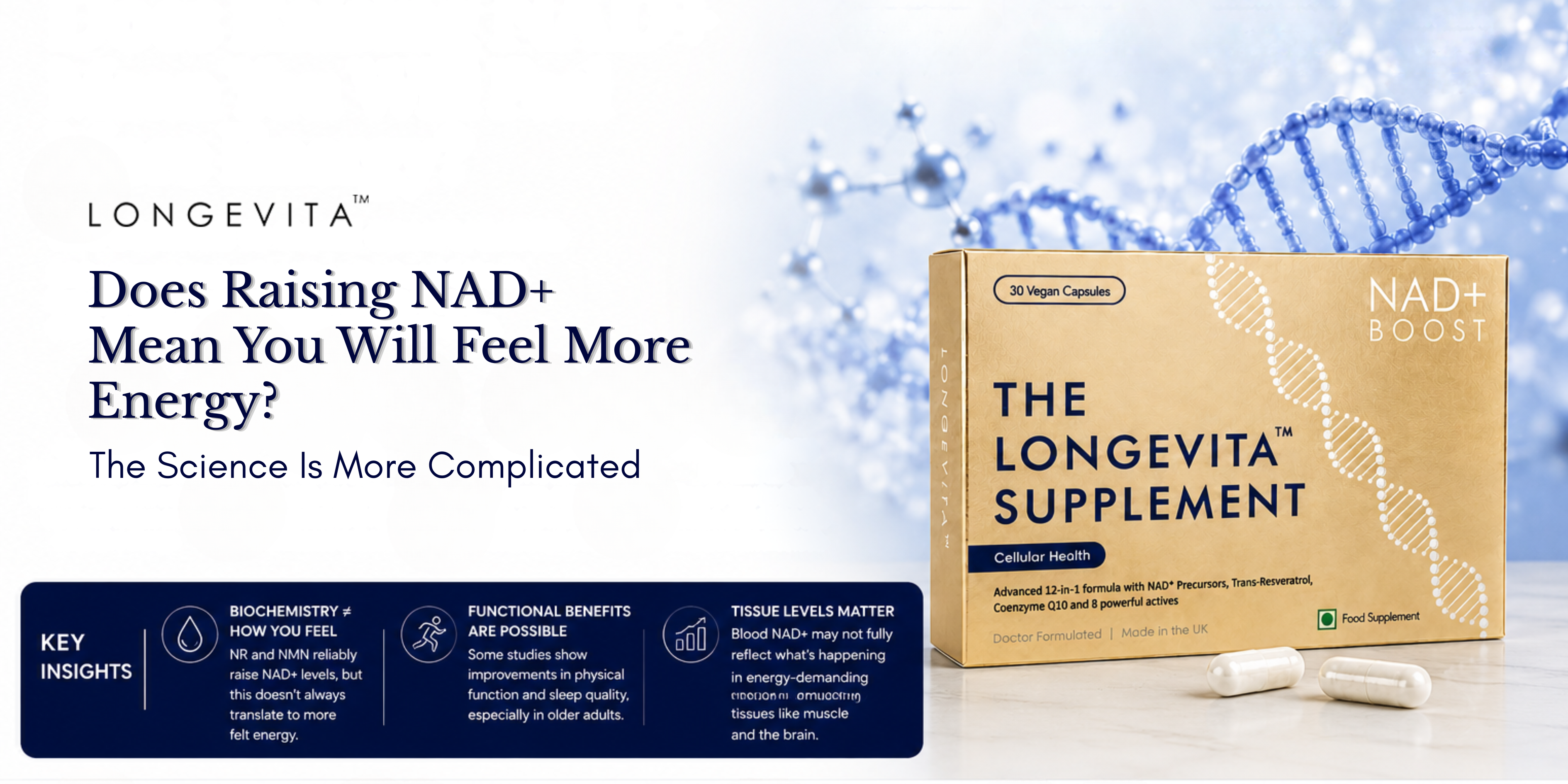
The actual science tells a more nuanced story. While NAD+ precursor supplementation reliably raises measurable NAD+ levels in the blood, human trials show that this biochemical change does not always translate into a felt sense of more energy, at least not in the way marketing claims often suggest (Yang et al., 2025).
Understanding the gap between mechanism and lived experience is essential to interpreting NAD+ research accurately, and to setting realistic expectations for what supplementation can and cannot do.
The Mechanism: Why NAD+ Should Matter for Energy
At the cellular level, the logic behind NAD+ and energy is well established. NAD+ functions as an essential electron carrier in mitochondrial respiration, the process by which cells convert nutrients into usable energy in the form of ATP (Sun, Wang, Xu & Zhao, 2025).
Without adequate NAD+, this energy-generating process becomes less efficient. Research has also linked declining tissue NAD+ to reduced activity of sirtuins, proteins that regulate mitochondrial function and metabolic efficiency, providing a plausible biological pathway connecting NAD+ status to cellular energy capacity (Imai & Guarente, 2014).
This mechanistic case is genuinely strong, and it's the reason NAD+ precursors such as nicotinamide mononucleotide (NMN) and nicotinamide riboside (NR) have become such a significant focus in longevity science.
The Myth: "More NAD+ Always Equals More Felt Energy"
Where the picture becomes more complicated is in translating this cellular mechanism into a subjective, day-to-day experience of vitality.
A 2025 randomised controlled trial in individuals with long-COVID found that ten weeks of nicotinamide riboside supplementation significantly increased NAD+ levels, but did not produce statistically significant improvements in fatigue, cognition, sleep or mood compared to placebo, when measured against the placebo group directly (Guzmán-Vélez et al., 2025).
This is an important distinction. The supplement did exactly what it was designed to do at the biochemical level, raise NAD+, but the primary comparison against placebo did not show a clear symptomatic benefit. Exploratory within-group analyses did suggest some improvement in fatigue, sleep and depression scores compared to participants' own baseline after ten weeks, hinting at a possible effect that larger trials will need to confirm (Guzmán-Vélez et al., 2025).
Similarly, a review of NMN and NR research found that while both compounds reliably and significantly increase NAD+ production, a recent clinical trial did not demonstrate significant improvement in physical performance parameters with NMN supplementation, despite the biochemical change being clearly present (Yang et al., 2025).
Where the Evidence Is More Encouraging
The picture is not uniformly negative. Several trials have found meaningful functional benefits alongside NAD+ increases, though the effects tend to be modest and specific rather than a general boost in energy.
In a double-blind, randomised, placebo-controlled study of healthy older adults aged 65 to 75, twelve weeks of NMN supplementation at 250 mg per day significantly raised blood NAD+ levels and was associated with a shorter 4-metre walking time compared to placebo, a recognised marker of physical function in older adults (Igarashi et al., 2024).
The same study found that the NMN group showed improved sleep quality relative to placebo, with lower scores for daytime dysfunction on the Pittsburgh Sleep Quality Index (Igarashi et al., 2024). Better sleep quality is one plausible route through which raised NAD+ could indirectly support how energetic someone feels, even without directly altering subjective energy levels.
Researchers involved in this line of work also note considerable individual variability in how NAD+ metabolism responds to supplementation, suggesting that baseline health status, age and existing NAD+ status may all influence whether a functional benefit becomes noticeable (Igarashi et al., 2024).
Why Might Raised NAD+ Not Translate to Felt Energy?
Several explanations help account for this apparent disconnect between mechanism and experience.
Fatigue is multifactorial. Subjective energy and fatigue are influenced by sleep quality, stress, mood, cardiovascular fitness, nutrition and underlying health conditions, not cellular NAD+ status alone. A change in one biochemical input is unlikely to overcome the combined influence of these other factors (Guzmán-Vélez et al., 2025).
Blood NAD+ may not reflect tissue-level status. Recent research indicates that whole-blood NAD+ levels can respond to supplementation without necessarily reflecting what is happening in the specific tissues, such as skeletal muscle, most relevant to physical performance and fatigue (Trętowicz et al., 2026).
Trial duration and dosing vary considerably. Human NAD+ precursor trials differ widely in dose, duration and population studied, from healthy older adults to those with underlying conditions like long-COVID, making it difficult to draw uniform conclusions about functional outcomes across the field (Yang et al., 2025).
Objective and subjective measures don't always align. A study can show a statistically significant improvement in an objective marker, such as walking speed, without participants necessarily reporting a noticeably different subjective sense of energy, and vice versa.
What This Means for How You Interpret NAD+ Research
None of this means NAD+ research is unreliable or that supplementation lacks value. It means the relationship between raising NAD+ and feeling more energetic is genuinely more nuanced than simplified marketing claims often suggest.
The strongest, most consistently replicated finding across human trials is that NAD+ precursors reliably raise measurable NAD+ levels (Yang et al., 2025). Functional outcomes, including physical performance, sleep quality and fatigue, show more mixed but still promising results, particularly in specific populations such as older adults and those with pre-existing NAD+-related depletion.
This distinction matters for setting realistic expectations. Supporting NAD+ status is best understood as supporting a foundational piece of cellular energy metabolism, one input among many that influence how energetic a person ultimately feels, rather than a guaranteed, immediate subjective effect.
Supporting Healthy Ageing
Because fatigue and energy are influenced by many interacting factors, supporting NAD+ metabolism works best as part of a broader approach to health rather than a standalone strategy.
Regular exercise has been shown to help preserve NAD+ salvage capacity in skeletal muscle with age, while quality sleep, balanced nutrition and stress management all support the biological systems that influence day-to-day vitality (de Guia et al., 2019).
Supplements may provide additional support, but they work best as part of a broader, multi-pathway approach to cellular health, addressing mitochondrial function, oxidative stress and inflammation together, rather than raising a single biomarker in isolation.
How Longevita™ Approaches NAD+ and Cellular Energy
The research summarised here points to an important conclusion: raising NAD+ alone is not guaranteed to translate into felt energy, because cellular energy metabolism depends on multiple interconnected systems working together, not a single molecule.
This is the scientific rationale behind The Longevita™ Supplement, a doctor-formulated, 12-ingredient longevity formula designed to target the key hallmarks of ageing by promoting cellular energy, helping manage senescent cell burden, and strengthening antioxidant and inflammation defence systems, rather than relying on a single NAD+ precursor in isolation.
At its core, Longevita™ combines Nicotinamide Riboside Chloride, which boosts NAD⁺ levels to activate sirtuins and enhance DNA repair, with Nicotinamide, which sustains NAD⁺ pools for mitochondrial energy and antioxidant defence. Because NAD+ alone does not guarantee felt energy, the formula pairs these precursors with Coenzyme Q10, which preserves mitochondrial ATP production and reduces oxidative stress directly at the site of energy generation, and Calcium Alpha Ketoglutarate, which enhances mitochondrial energy and reduces inflammaging via epigenetic modulation.
To address the broader systems that influence day-to-day vitality, Longevita™ includes Trans-Resveratrol, which activates SIRT1 for mitochondrial function while promoting autophagy and DNA repair, and Pterostilbene, which activates SIRT1/AMPK pathways to enhance mitochondrial biogenesis. Piperine upregulates antioxidant enzymes and enhances mitochondrial biogenesis via PGC-1α, while Ginseng activates antioxidant pathways and promotes autophagy via SIRT1 and FOXO signalling, an ingredient with a long-standing association with vitality and resilience. Fisetin supports the clearance of senescent cells, and L-Theanine, Lutein and Hyaluronic Acid round out the formula's support for cognition, focus, visual health and skin.
Formulated by a doctor and longevity specialist, and manufactured in a GMP-certified, USFDA-registered facility with third-party testing for potency and contaminants, Longevita™ is built on the premise that supporting how someone feels day-to-day requires addressing mitochondrial function, oxidative stress and inflammation together with NAD+ synthesis, not relying on raised NAD+ alone.
The Bottom Line
Raising NAD+ through supplementation is one of the most consistently replicated findings in longevity science, but whether that translates into a felt sense of more energy is a separate and more complicated question. Human trials show mixed results: some studies find measurable functional benefits like improved walking speed and sleep quality, while others, including a recent long-COVID trial, find that raised NAD+ does not automatically produce statistically significant symptomatic improvement against placebo.
Understanding this distinction between biochemical mechanism and lived experience is essential to setting realistic expectations, and reinforces why a multi-pathway approach, addressing mitochondrial function and oxidative stress alongside NAD+ synthesis, may offer a more complete strategy for supporting cellular energy and healthy ageing.
Explore The Longevita™ Supplement, a doctor-formulated, 12-ingredient longevity formula designed to support NAD+ status, mitochondrial function and cellular resilience as part of a daily routine.
FAQs
1. Does raising NAD+ always make you feel more energetic?
Not necessarily. Human trials consistently show that NAD+ precursors raise measurable NAD+ levels, but functional and subjective energy outcomes are more mixed, with some studies showing benefits like improved walking speed or sleep, and others showing no significant difference versus placebo.
2. Why might NAD+ supplementation not improve felt energy in some studies?
Subjective energy and fatigue are influenced by many factors beyond NAD+ status, including sleep, stress, mood and cardiovascular fitness. Blood NAD+ levels also may not fully reflect NAD+ status in the specific tissues most relevant to physical performance.
3. Which functional benefits have been shown in NAD+ precursor trials?
Some randomised controlled trials in older adults have found NMN supplementation associated with improved walking speed and better sleep quality compared to placebo, alongside significantly raised blood NAD+ levels.
4. Is it still worth supporting NAD+ status if energy benefits are inconsistent?
Yes. NAD+ plays a well-established role in mitochondrial function, DNA repair and sirtuin activation regardless of whether felt energy improves immediately, which is why many longevity formulations combine NAD+ precursors with ingredients supporting mitochondrial and antioxidant function together.
References
de Guia, R.M., Agerholm, M., Nielsen, T.S., Consitt, L.A., Søgaard, D., Helge, J.W., Larsen, S., Brandauer, J., Houmard, J.A. & Treebak, J.T. (2019) 'Aerobic and resistance exercise training reverses age-dependent decline in NAD+ salvage capacity in human skeletal muscle', Physiological Reports, 7(11), e14139.
Guzmán-Vélez, E. et al. (2025) 'Effects of nicotinamide riboside on NAD+ levels, cognition, and symptom recovery in long-COVID: a randomized controlled trial', eClinicalMedicine, The Lancet.
Igarashi, M. et al. (2024) 'Ingestion of β-nicotinamide mononucleotide increased blood NAD levels, maintained walking speed, and improved sleep quality in older adults in a double-blind randomized, placebo-controlled study', GeroScience, 46(5), pp. 4671–4688.
Imai, S. & Guarente, L. (2014) 'NAD+ and sirtuins in aging and disease', Trends in Cell Biology, 24(8), pp. 464–471.
Sun, J.Y., Wang, Z.F., Xu, W.H. & Zhao, J. (2025) 'NAD+ glycohydrolases-CD38 as a therapeutic target in aging: physiological roles, molecular mechanisms, and future opportunities in anti-aging research', Biochemical and Biophysical Research Communications, in press.
Trętowicz, M.M., Scantlebery, A.M.L., Schomakers, B.V., Eroğlu, K.D., van Weeghel, M., Spek, V. et al. (2026) 'Human whole-blood NAD+ levels do not vary with age or lifestyle interventions', Nature Metabolism, advance online publication.
Yang et al. (2025) 'An updated review on the mechanisms, pre-clinical and clinical comparisons of nicotinamide mononucleotide (NMN) and nicotinamide riboside (NR)', Food Frontiers, Wiley Online Library.