Autophagy Is Having a Longevity Moment. Here's What the Science Really Says.
Somewhere between a Nobel Prize and a wave of fasting-focused social media, autophagy went from a niche cell biology term to a wellness buzzword. You'll now find it in podcast titles, supplement labels and morning-routine videos, usually attached to a promise: trigger autophagy, and you'll clean out your cells and slow ageing.
The excitement isn't baseless. Autophagy is one of the most important processes in cell biology, and its link to ageing is real. But the popular version skips the harder questions. How much do we actually know about autophagy in humans, as opposed to yeast, worms and mice? Can a supplement meaningfully influence it? This article sorts through the trend, the biology and the evidence, and explains how autophagy fits into Longevita's broader approach to cellular ageing.
Why Autophagy Became a Trend
Two things pushed autophagy into the mainstream. The first was scientific credibility: the Nobel recognition gave a once-obscure process a public profile. The second was its natural fit with popular longevity conversations around fasting, exercise, nutrition and healthy ageing, all of which are often discussed in terms of how they might influence cellular cleanup.
The trouble is that trends compress nuance. Autophagy isn't a single event you can trigger on demand and measure at home. It's a dynamic, tissue-specific process, and measuring it properly in people is difficult, which is one reason the human evidence is still catching up with the enthusiasm. Understanding that gap is the first step to reading autophagy claims critically.
What Autophagy Actually Is
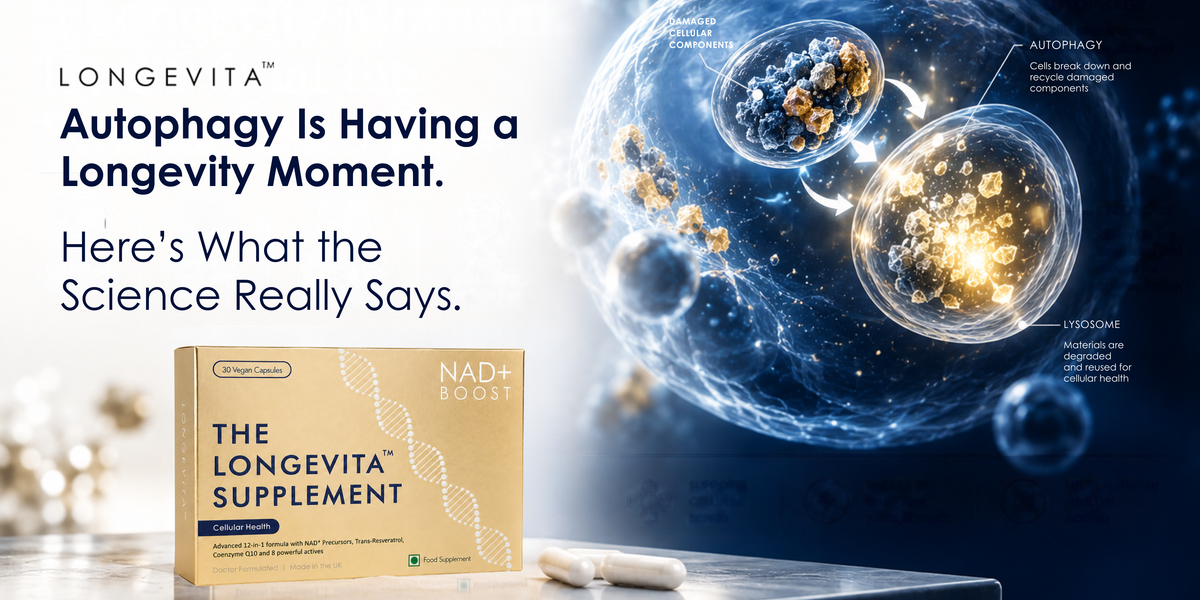
The word comes from the Greek for "self-eating," which sounds alarming but describes something essential. Autophagy is the cell's internal recycling system. Damaged proteins, worn-out organelles and cellular debris are packaged into vesicles and delivered to lysosomes, where they're broken down and reused.
Yoshinori Ohsumi received the Nobel Prize for describing the autophagy-related (ATG) genes that control the process, and hundreds of groups have since expanded on how it works (Autophagy: The Last Antioxidant to Unravel, PMC). Autophagy is also tightly linked to oxidative stress, since it clears damaged components that would otherwise generate more reactive oxygen species.
For a longevity brand, this matters because impaired cellular cleanup is one of the hallmarks of ageing that Longevita's formulation targets. According to Longevita's published science, healthy ageing depends on clearing damaged proteins, recycling worn-out cell components and managing the senescent cells that accumulate over time, which is exactly the territory autophagy covers.
Why Autophagy Is Linked to Ageing
The central idea is simple: if cells stop clearing damage efficiently, damage accumulates. The cell's capacity for autophagic degradation declines with age, and this may itself contribute to ageing. The loss of autophagy genes with age correlates with the build-up of damaged proteins, and lower levels of the autophagy gene Beclin 1 have been observed in ageing human brains (Autophagy: An Emerging Anti-Aging Mechanism, PMC).
Upstream control systems matter too. Age-related changes in nutrient and energy sensors such as mTORC1 and AMPK can reduce autophagy initiation as we get older (Molecular Mechanisms of Autophagy Decline during Ageing, 2024). That's why Longevita's science page highlights AMPK, described as the body's cellular fuel gauge, whose signalling can weaken with age.
The link with NAD+ is just as direct. Sirtuin enzymes that promote autophagy depend on NAD+, and NAD+ levels fall with age, a decline we explore in our article on why NAD+ falls with age and the role of CD38 and inflammaging.
What the Science Really Says
This is where the trend tends to outrun the evidence, so precision matters.
Model organisms: strong evidence. Studies in worms, flies and mice consistently show autophagy efficiency falling with age, and that preventing this decline or boosting autophagy improves cellular health (Frontiers in Bioscience-Landmark, 2025).
Humans: thinner and more complicated. A recent analysis noted that direct evidence for age-related autophagy decline across human cell and tissue types remains limited, that autophagy is not uniformly reduced during ageing, and that it varies by cell type and sex and is associated with physical fitness (Autophagy flux during ageing, bioRxiv preprint, 2026). Other reviewers describe autophagy as dysregulated with age rather than simply inhibited (Frontiers in Bioscience-Landmark, 2025).
The brain: especially limited. Three gene expression analyses suggested age-related downregulation of macroautophagy in the human brain, but the reviewers concluded the question hasn't been investigated sufficiently (Influence of Normal Ageing on Brain Autophagy, Frontiers in Ageing Neuroscience, 2019).
That doesn't mean autophagy is unimportant. It means anyone promising a precise, measurable "autophagy boost" from a single intervention is ahead of the data.
Can Supplements Influence Autophagy?
Several natural compounds have shown autophagy-inducing activity in laboratory work. The mechanistic case is real, but the evidence sits mostly at the cell and animal level.
Resveratrol is among the best characterised. Its induction of autophagy requires SIRT1, the NAD+-dependent deacetylase, and in cell and animal experiments,s low doses of resveratrol and spermidine induced autophagy synergistically, ly where neither worked alone (Spermidine and resveratrol induce autophagy by distinct pathways, Journal of Cell Biology). Autophagy is also required for the lifespan-extending effects of both compounds in model organisms (Autophagy mediates pharmacological lifespan extension by spermidine and resveratrol, Ageing). Different compounds can reach autophagy through different, complementary routes.
Human data is earlier-stage. A registered resveratrol trial is examining autophagy markers and cardiovascular function in older adults, noting that although resveratrol induces autophagy in animals, evidence in humans is lacking (NCT02909699). It's the same honest position we took in our articles on fisetin and the future of senolytics, and senolytics as one of longevity science's biggest frontiers.
How Longevita Approaches Autophagy
Rather than treating autophagy as a standalone target, Longevita addresses it as one connected part of a multi-pathway formulation. According to the brand's published ingredient science, several of its twelve ingredients support autophagy through different routes:
• Trans-resveratrol activates SIRT1 for mitochondrial function and promotes autophagy and DNA repair.
• Ginseng activates antioxidant pathways and promotes autophagy via SIRT1 and FOXO signalling.
• L-theanine boosts glutathione and activates autophagy while supporting mitochondrial health.
• Pterostilbene activates SIRT1/AMPK pathways and enhances mitochondrial biogenesis with superior bioavailability.
Because SIRT1 is NAD+-dependent, these ingredients sit alongside nicotinamide riboside chloride and nicotinamide, which support NAD+ availability, as covered in NR vs nicotinamide: why Longevita uses both NAD+ precursors. Fisetin, which removes senescent cells and supports mitochondrial function and glutathione, addresses the neighbouring problem of damaged cells that autophagy can't clear alone.
This layered logic mirrors the mitochondrial support covered in our piece on CoQ10 and its role in supporting cellular energy and healthy ageing: cleanup, energy production and antioxidant defence are interconnected, and a formula addressing only one leaves the others exposed. Longevita is doctor-formulated, research-backed and intelligently dosed, and manufactured in a GMP-certified, USFDA-registered facility in the UK.
What This Means in Practice
• Autophagy is important, but not a switch. It's continuously regulated and varies by tissue, age and sex.
• Lifestyle remains foundational. Physical fitness is associated with healthier autophagy flux in human research.
• Supplements are support, not a shortcut. Their credible role is supporting pathways that decline with age, ideally as a consistent daily routine.
• Be sceptical of certainty. Where human evidence is still developing, honest brands say so.
As with any supplement, anyone on prescription medication, particularly blood thinners or drugs metabolised through cytochrome P450 pathways, should consult a healthcare professional first.
The Bottom Line
Autophagy earns its place at the centre of longevity science. It's the cell's essential recycling system; it tends to become less efficient with age in model organisms, and it's tightly connected to NAD+, sirtuins, AMPK and oxidative stress. But the human evidence is still developing, and the responsible framing is a promising, interconnected pathway rather than a proven, controllable lever.
That's why Longevita treats autophagy as one strand within a twelve-ingredient formulation aimed at the wider hallmarks of ageing rather than promising a single-mechanism fix.
Precision-calibrated cellular renewal isn't built on one buzzword. It's engineered through complementary, evidence-backed pathways working together with daily consistency. Explore the doctor-formulated, research-led longevity formulation behind Longevita.
FAQs
1. What is autophagy in simple terms?
Autophagy is the cell's built-in recycling process. It collects damaged proteins and worn-out cell parts, breaks them down in lysosomes and reuses the components, helping keep cells efficient.
2. Does autophagy really decline with age?
The evidence is strongest in model organisms. In humans, it's more nuanced: autophagy isn't uniformly reduced with age and varies by cell type and sex, and direct evidence across human tissues remains limited.
3. Can supplements really boost autophagy?
Some compounds, including resveratrol, have induced autophagy in cell and animal studies, and resveratrol's effect depends on SIRT1. Human confirmation is still being built, so supplements are best seen as supporting the pathways involved.
4. Which Longevita ingredients support autophagy?
According to Longevita's published ingredient science, trans-resveratrol, ginseng and L-theanine support autophagy, while pterostilbene supports the SIRT1/AMPK pathways that regulate it.
5. How is autophagy connected to NAD+?
Sirtuins such as SIRT1, which help drive autophagy, need NAD+ to function. Because NAD+ declines with age, supporting NAD+ availability supports the sirtuin pathways autophagy relies on.
References
Autophagy - An Emerging Anti-Aging Mechanism, PMC. Available at: pmc.ncbi.nlm.nih.gov/articles/PMC3674854/
Autophagy flux during human ageing is sex- and cell type-specific, and is associated with physical fitness (2026) bioRxiv preprint. Available at: biorxiv.org/content/10.64898/2026.05.15.725565
Autophagy mediates pharmacological lifespan extension by spermidine and resveratrol, Ageing. DOI: 10.18632/aging.100110.
Autophagy: The Last Antioxidant to Unravel, PMC. Available at: ncbi.nlm.nih.gov/pmc/articles/PMC12562064/
ClinicalTrials.gov Identifier NCT02909699: Cardiovascular Health of Older Adults and Resveratrol (CORE).
Frontiers in Bioscience-Landmark (2025) Review on autophagy ageing. Available at: imrpress.com/journal/FBL/30/3/10.31083/FBL27091
Influence of Normal Ageing on Brain Autophagy: A Complex Scenario (2019) Frontiers in Ageing Neuroscience, 11, Article 49.
Molecular Mechanisms of Autophagy Decline during Ageing (2024) Cells, 13. Available at: pmc.ncbi.nlm.nih.gov/articles/PMC11352966/
Spermidine and resveratrol induce autophagy by distinct pathways converging on the acetylproteome, Journal of Cell Biology, 192(4), pp. 615–629.