Cellular Cleanup vs Cellular Energy: Why Longevity Science Targets Both
Ask ten people what causes ageing, and you'll get ten different answers: wrinkles, slower metabolism, joint pain, memory that isn't as sharp as it used to be. Geroscience researchers see something more specific underneath all of it: two parallel systems inside every cell, both breaking down with age, both contributing to the same visible decline, but in genuinely different ways.
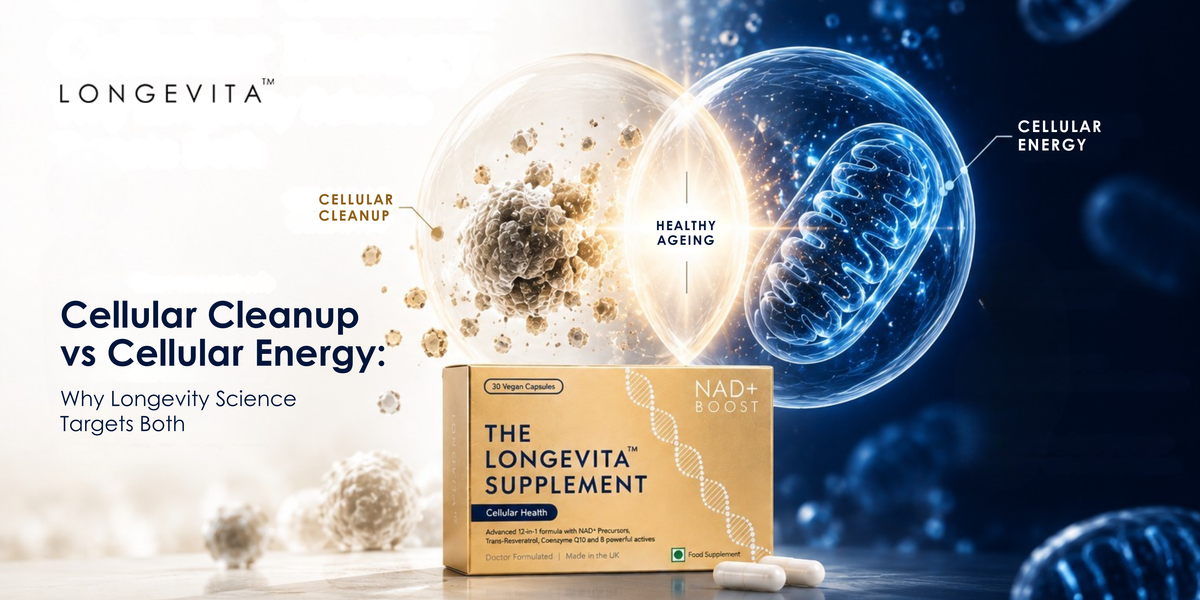
One system is about energy: how efficiently cells produce the fuel they need to function. The other is about cleanup: how well the body clears out damaged, dysfunctional cells and debris that accumulate over decades. Most longevity supplements pick a side, chasing energy production or cellular cleanup, rarely both. Longevita's formulation is built around the premise that this is a false choice and that fisetin, targeting cleanup, and NAD+ precursors, targeting energy, need to work together, not in isolation. This article explains why.
Two Different Problems, Both Rooted in Ageing
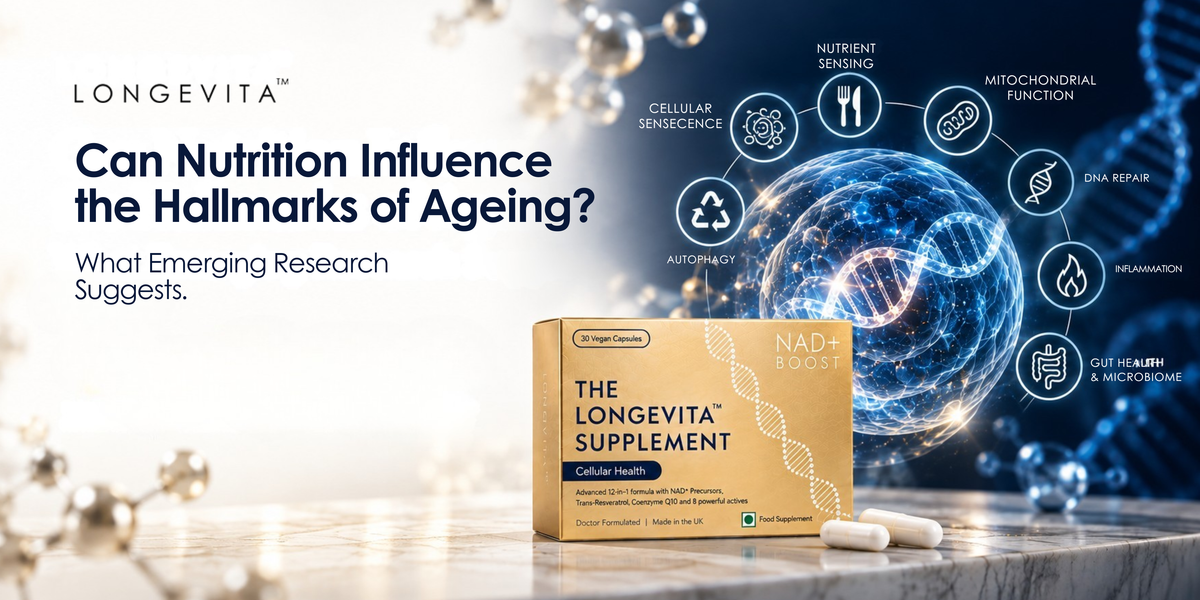
According to Longevita's own published science, healthy ageing depends on maintaining cellular energy production while simultaneously clearing damaged proteins, recycling worn-out cell components and managing the senescent cells that accumulate over time. That single sentence contains two distinct biological challenges, worth separating clearly before looking at how they interact.
The energy problem centres on NAD+ (nicotinamide adenine dinucleotide), a coenzyme involved in hundreds of metabolic reactions. It's essential for energy production and repair, acting as a substrate for sirtuins, which regulate metabolism and stress response, and PARPs, which consume NAD+ to repair damaged DNA (Covarrubias et al., 2020). NAD+ levels decline progressively with age, a decline causally linked to neurodegeneration, sarcopenia, metabolic disease and frailty (Fang et al., 2017). Less NAD+ means less efficient mitochondrial energy production and weaker DNA repair capacity, system-wide.
The cleanup problem centres on cellular senescence: cells that have permanently stopped dividing but refuse to die, instead persisting and secreting inflammatory cytokines and tissue-degrading enzymes known as the senescence-associated secretory phenotype, or SASP. This signalling drives the chronic, low-grade inflammation researchers call inflammaging, which damages surrounding healthy tissue and accelerates the very energy decline described above.
These two problems aren't running on parallel, unconnected tracks. They actively feed each other, which is the central reason a longevity strategy addressing only one of them is incomplete.
How Cellular Cleanup and Cellular Energy Are Connected
Senescent cells drive up the activity of CD38, an immune enzyme that degrades NAD+ and is a major contributor to its age-related decline (Camacho-Pereira et al., 2016). We've explored this specific mechanism and the broader inflammaging connection in our article on why NAD+ falls with age and the role of CD38 and inflammaging. More senescent cells means more CD38 activity, which means faster NAD+ depletion.
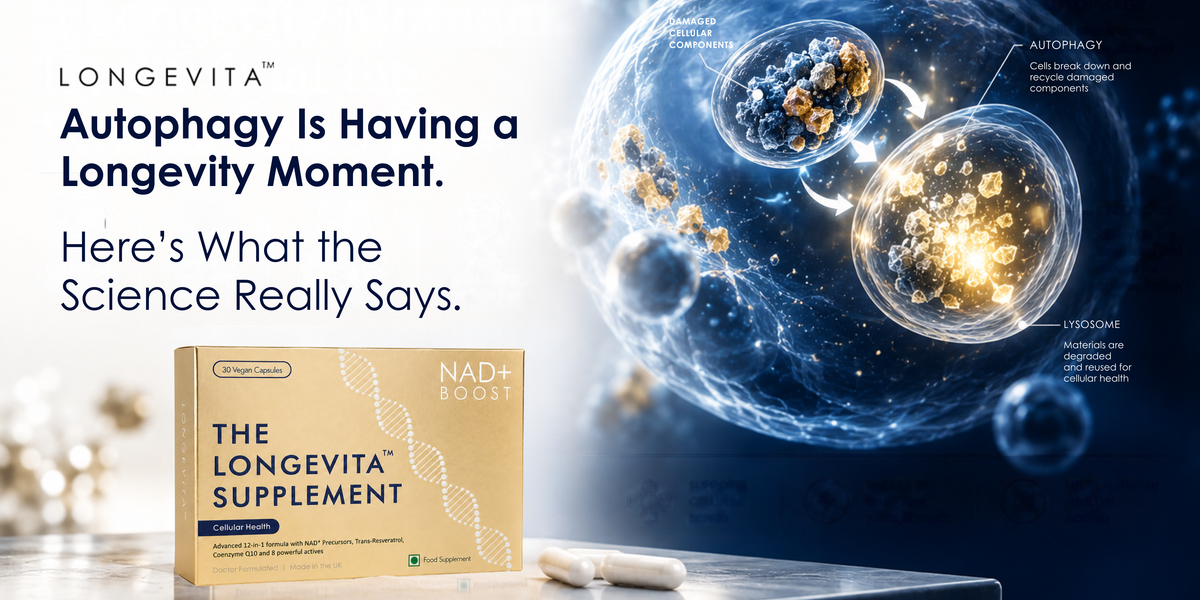
The reverse is also true. NAD+-dependent sirtuins, particularly SIRT1, support autophagy, the cell's internal recycling process that clears the damaged proteins and organelles that would otherwise burden a cell toward senescence in the first place. When NAD+ falls, sirtuin activity falls with it, weakening the very cleanup systems that would otherwise help prevent senescent cell accumulation. Low NAD+ makes cleanup harder; poor cleanup accelerates NAD+ loss. It's a reinforcing cycle, not two separate problems running side by side.
This is why treating either issue in isolation leaves a gap. A NAD+-only strategy replenishes the coenzyme cells need for energy and repair, but does nothing to directly clear the senescent cells whose inflammatory signalling is actively degrading that NAD+ pool. A senescence-only strategy might reduce some inflammatory burden, but does nothing to restore the energy-production and DNA-repair capacity that NAD+ decline has already compromised.
What Fisetin Contributes to the Cleanup Side
Fisetin is a flavonol found in fruits and vegetables, most concentrated in strawberries, and it has emerged as one of the most closely studied natural senolytic compounds that selectively clear senescent cells. According to Longevita's ingredient science, fisetin removes senescent cells and supports mitochondrial function and glutathione, working by disrupting the anti-apoptotic survival pathways senescent cells rely on to resist their own programmed cell death (Yousefzadeh et al., 2018).
The preclinical evidence is genuinely strong. In the foundational 2018 study, aged mice treated with fisetin showed reduced senescent cell markers across multiple tissues, and even mice that began treatment relatively late in life saw close to a 10% extension in remaining lifespan (Yousefzadeh et al., 2018). Human research is earlier-stage but encouraging: pilot studies including COVFIS-HOME confirmed fisetin's safety in older adults at doses used in prior over-the-counter sales, with no significant toxicity identified so far (COVFIS-HOME Protocol, ClinicalTrials.gov NCT04771611). We've covered fisetin's mechanism and the honest state of its human evidence in fisetin and the future of senolytics: what human research actually shows, and the broader research landscape in senolytics are one of longevity science's biggest frontiers.
What NAD+ Precursors Contribute to the Energy Side
On the energy side, Longevita uses two complementary precursors rather than relying on one. Nicotinamide riboside chloride boosts NAD+ levels to activate sirtuins and enhance DNA repair, and the clinical data supports this directly: an 8-week randomised, placebo-controlled trial found 1,000 mg/day of NR chloride raised whole-blood NAD+ by roughly 142% within two weeks, sustained for the remainder of the study, with no flushing or major adverse events (Conze et al., 2019).
Alongside it, nicotinamide sustains NAD+ pools for mitochondrial energy and antioxidant defence, with its strongest evidence in PARP-dependent DNA repair; restoring niacin in human skin cells reverses UV-induced DNA damage accumulation almost immediately (Benavente et al., 2012). We've written specifically about why both precursors are included together in NR vs nicotinamide: why Longevita uses both NAD+ precursors, and made the broader case for daily oral support over episodic IV therapy in " Can you support NAD+ without an IV? The science behind Longevita.
Why Longevita Pairs Fisetin With NAD+ Precursors Specifically
Given that senescent cell accumulation accelerates NAD+ depletion, and NAD+ depletion weakens the sirtuin-driven cleanup systems that would otherwise help clear senescent cells, addressing both sides of this loop at once is a more defensible strategy than betting on either alone.
Longevita's twelve-ingredient formulation reflects this directly, combining fisetin with nicotinamide riboside chloride and nicotinamide as core components alongside supporting compounds like pterostilbene, which activates SIRT1/AMPK pathways and reinforces the same mitochondrial biogenesis and repair machinery both fisetin and the NAD+ precursors interact with. This mirrors the logic in our article on CoQ10 and its role in supporting cellular energy and healthy ageing, where mitochondrial antioxidant support works alongside NAD+ precursors rather than as a standalone fix. Cellular ageing doesn't happen along a single pathway, and Longevita's approach, twelve evidence-backed ingredients spanning NAD+ precursors, senolytics and advanced antioxidants, is built to address that complexity directly.
Safety Considerations
Both sides of this pairing carry well-documented safety profiles at the doses studied. The NR chloride trial referenced above reported no flushing and no major adverse events even at 1,000 mg/day, with stable blood lipids throughout (Conze et al., 2019). Fisetin has been sold as an over-the-counter supplement for years, with no significant proven toxicity reported to date. As with any bioactive supplement, anyone on prescription medication, particularly blood thinners or drugs metabolised through cytochrome P450 pathways, should consult a healthcare professional before starting a new daily protocol.
The Bottom Line
Cellular energy decline and cellular cleanup failure aren't two separate ageing problems running in parallel; they're a reinforcing loop. Senescent cells accelerate NAD+ loss through increased CD38 activity, and falling NAD+ weakens the sirtuin-dependent systems that would otherwise help clear senescent cells before they accumulate. Addressing only one side of that loop leaves the other actively working against it.
That's the specific reasoning behind why Longevita combines fisetin, targeting cellular cleanup, with nicotinamide riboside and nicotinamide, targeting cellular energy, in a single daily formulation rather than isolating either mechanism on its own.
Precision-calibrated cellular renewal isn't built on one side of the equation; it's engineered through the convergence of cleanup and energy pathways working together daily. Explore the doctor-formulated, dual-pathway longevity formulation behind Longevita.
FAQs
1. Why does longevity science target both cellular cleanup and cellular energy instead of just one?
Because the two systems are interconnected rather than independent, senescent cells are the target of cellular cleanup compounds like fisetin, which drive up the activity of the enzyme CD38, which accelerates NAD+ depletion. Meanwhile, falling NAD+ weakens the sirtuin-dependent pathways that support cellular cleanup in the first place. Addressing only one side leaves the reinforcing loop between them unaddressed.
2. What is the connection between fisetin and NAD+?
Fisetin targets senescent cells directly, reducing the inflammatory signalling (SASP) they produce, which in turn reduces the CD38 activity that degrades NAD+. NAD+ supports the sirtuin enzymes that drive autophagy, the cellular cleanup process that helps prevent healthy cells from becoming senescent in the first place. The two pathways influence each other continuously.
3. Is it safe to take a NAD+ precursor and a senolytic like fisetin together?
Available human safety data on both compound categories is encouraging. Clinical trials on NR chloride at doses up to 1,000 mg/day reported no major adverse events, and fisetin has been sold as an over-the-counter supplement with no significant proven toxicity reported to date. Those on prescription medication should consult a healthcare professional first.
4. Does Longevita's formula target cellular energy and cellular cleanup together?
Yes. Longevita combines fisetin for cellular cleanup with nicotinamide riboside chloride and nicotinamide for cellular energy, alongside supporting ingredients like pterostilbene, across a twelve-ingredient daily formula designed to address the interconnected hallmarks of cellular ageing rather than a single isolated pathway.
References
Benavente, C.A. et al. (2012) 'Cellular NAD Replenishment Confers Marked Neuroprotection against UV-Induced Cell Death', PLOS ONE, 7(7), e42276.
Camacho-Pereira, J., Tarragó, M.G., Chini, C.C.S., Nin, V., Escande, C., Warner, G.M., Puranik, A.S., Schoon, R.A., Reid, J.M., Galina, A. & Chini, E.N. (2016) 'CD38 dictates age-related NAD decline and mitochondrial dysfunction through an SIRT3-dependent mechanism', Cell Metabolism, 23(6), pp. 1127–1139.
Conze, D., Brenner, C. & Kruger, C.L. (2019) 'Safety and metabolism of long-term administration of NIAGEN (nicotinamide riboside chloride) in a randomised, double-blind, placebo-controlled clinical trial of healthy overweight adults', Scientific Reports, 9, Article 9772.
Covarrubias, A.J., Perrone, R., Grozio, A. & Verdin, E. (2020/2021) 'NAD+ metabolism and its roles in cellular processes during ageing', Nature Reviews Molecular Cell Biology, 22, pp. 119–141.
COVFIS-HOME Protocol (2021) Pilot Study of Fisetin to Alleviate Dysfunction and Decrease Complications in Older Adults, ClinicalTrials.gov Identifier: NCT04771611.
Fang, E.F. et al. (2017) 'NAD+ in Ageing: Molecular Mechanisms and Translational Implications', Trends in Molecular Medicine, 23(10), pp. 899–916.
Yousefzadeh, M.J., Zhu, Y., McGowan, S.J., Angelini, L., Fuhrmann-Stroissnigg, H., Xu, M., Ling, Y.Y., Melos, K.I., Pirtskhalava, T., Inman, C.L., McGuckian, C., Wade, E.A., Kato, J.I., Grassi, D., Wentworth, M., Burd, C.E., Arriaga, E.A., Ladiges, W.L., Tchkonia, T., Kirkland, J.L., Robbins, P.D. & Niedernhofer, L.J. (2018) 'Fisetin is a senotherapeutic that extends health and lifespan', EBioMedicine, 36, pp. 18–28.