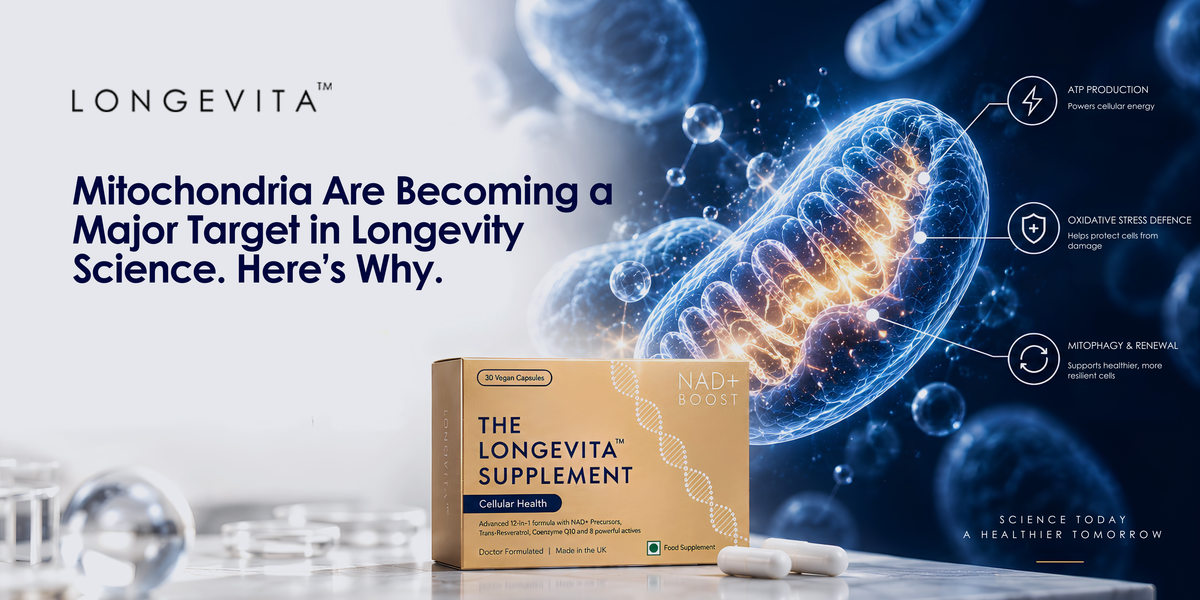
Mitochondria Are Becoming a Major Target in Longevity Science. Here's Why?
Not long ago, mitochondria were mostly a school-biology footnote: the "powerhouse of the cell." Today they sit near the centre of longevity research. Geroscientists, drug developers and nutrition researchers are all asking the same thing: if the cell's energy machinery wears down with age, can it be supported?
The answer is more interesting, and more complicated, than most headlines suggest. Mitochondrial decline in older adults is well documented. What can be done about it is less settled, and some of the most hyped approaches have produced mixed results in human trials. This article covers why mitochondria became such a focus, what the evidence shows, where it falls short, and how Longevita approaches mitochondrial support.
Why Mitochondria Matter So Much to Ageing?
Mitochondria convert nutrients into ATP, the molecule cells spend as energy. They are also the major producers of reactive oxygen species, which damage DNA, proteins and lipids if they aren't quenched quickly (Skeletal muscle mitochondria and aging: a review, 2012). That dual role, energy factory and main source of oxidative stress, is why they feature so heavily in ageing biology.
In their 2023 update to the hallmarks of ageing, López-Otín and colleagues list mitochondrial dysfunction among the antagonistic hallmarks, responses that begin as protective but turn harmful when they become chronic (López-Otín et al., 2023). Longevita's science page frames it in plain terms: NAD⁺ and mitochondria help power cellular energy and repair, and both decline with age.
What Actually Happens to Mitochondria With Age?
Human tissue data supports this. In human skeletal muscle, older samples showed reduced mitochondrial DNA, lower levels of several mitochondrial proteins and more oxidative DNA damage, pointing to both fewer mitochondria and altered function in those that remain (Decline in skeletal muscle mitochondrial function with aging in humans, PNAS, 2005). Reviews describe a consistent pattern: more mitochondrial DNA mutations, reduced total mitochondrial content and lower maximal respiratory capacity, at least in sedentary individuals (Skeletal muscle mitochondria and aging: a review, 2012). That qualifier matters, and it's one reason physical activity keeps appearing in this research.
The control systems weaken too. Reduced PGC-1α induction and weaker AMPK signalling are linked to the age-related fall in mitochondrial biogenesis, the building of new mitochondria (Frontiers in Cell and Developmental Biology review, 2025). One caution: whether mitochondrial dysfunction drives ageing or results from it remains debated (Skeletal muscle mitochondria and aging: a review, 2012). The association with decline is clear. The causal arrow is less so.
Quality Control Matters as Much as Output
Building new mitochondria is only half the equation. Cells also have to remove damaged ones through mitophagy, a selective form of autophagy. Reviews of ageing muscle report that mitophagy becomes impaired with age, and that weaker mitophagy signalling may in turn hinder biogenesis (Perspectives on mitochondrial dysfunction in the regeneration of aging skeletal muscle, 2025). Damaged mitochondria that linger keep generating oxidative stress instead of energy. That is why cellular cleanup and cellular energy are increasingly treated as linked problems, a theme we explore in our piece on autophagy and what the science really says. It also explains why Longevita's ingredient science includes compounds described as promoting autophagy, such as trans-resveratrol and L-theanine, alongside its energy-focused ones.
Why the Interest Has Surged?
Mitochondria connect to nearly every other mechanism in the hallmarks framework, which the authors describe as functionally related to one another (López-Otín et al., 2023). NAD+ is a good example. It fuels sirtuins that regulate mitochondrial function, and the NAD+-degrading enzyme CD38 becomes more active with age. Camacho-Pereira and colleagues showed in mice that CD38 drives age-related NAD+ decline and mitochondrial dysfunction through a SIRT3-dependent mechanism (Camacho-Pereira et al., 2016). We unpack that loop in why NAD+ falls with age and the role of CD38 and inflammaging. Because the hallmarks interact, supporting mitochondria also touches senescence, inflammation and nutrient sensing, which is why mitochondrial support appears in so many longevity strategies.
What Human Trials Show Including the Disappointing Parts
This is where the honest version diverges from the marketing version.
NAD+ precursors. Nicotinamide riboside (NR) reliably raises NAD+ metabolites, but its effect on mitochondrial function in human muscle has been underwhelming. In a randomized crossover trial, 12 older men took 1 g of NR daily for 21 days. Muscle NAD+ metabolites rose, but muscle mitochondrial bioenergetics did not change (Elhassan et al., 2019). A longer trial in obese, insulin-resistant men found no change in mitochondrial respiration, content or morphology (Dollerup et al., 2020), and a review of NR in humans noted the same pattern across studies (What is really known about the effects of nicotinamide riboside supplementation in humans, PMC).
That doesn't make NAD+ support pointless. These trials were short, enrolled specific groups and measured one tissue. NR's effects on NAD+ levels, on inflammatory signatures in older muscle (Elhassan et al., 2019) and on safety are better established. But "raises NAD+" and "boosts mitochondria" are different claims, and selling the second on the strength of the first runs ahead of the data.
Coenzyme Q10. CoQ10 sits in the electron transport chain, and the body's own production falls with age. The best-known randomized evidence is KiSel-10, in which 443 elderly Swedish adults received selenium plus CoQ10 or placebo for four years. At 12 years, cardiovascular mortality was 28.1% in the supplemented group versus 38.7% on placebo (Alehagen et al., 2018). The caveats are real: CoQ10 was combined with selenium, the population was low in selenium, and the endpoint was cardiovascular mortality rather than a direct mitochondrial measure. Still, it is one of the more substantial randomized datasets on a mitochondrial nutrient in older adults. We cover the mechanism in our CoQ10 and healthy ageing article.
How Longevita Approaches Mitochondrial Support?
Given that picture, relying on one mitochondrial lever would be a thin bet. According to Longevita's published science, The Longevita™ Supplement supports NAD⁺ availability and mitochondrial function to help maintain energy, stamina and cellular resilience over time. Its mitochondria-relevant ingredients, as described on the ingredients pages, include:
-
Nicotinamide riboside chloride: boosts NAD⁺ levels to activate sirtuins and enhance DNA repair.
-
Nicotinamide: sustains NAD⁺ pools for mitochondrial energy and antioxidant defense.
-
Calcium alpha ketoglutarate: enhances mitochondrial energy and reduces inflammaging via epigenetic modulation.
-
Trans-resveratrol: activates SIRT1 for mitochondrial function and promotes autophagy and DNA repair.
-
Pterostilbene: activates SIRT1/AMPK pathways and enhances mitochondrial biogenesis with superior bioavailability.
-
Piperine: upregulates antioxidant enzymes and enhances mitochondrial biogenesis via PGC-1α.
-
Fisetin: removes senescent cells and supports mitochondrial function and glutathione.
-
L-theanine: boosts glutathione and activates autophagy while supporting mitochondrial health.
-
Coenzyme Q10: preserves mitochondrial ATP production and reduces oxidative stress system-wide.
The logic maps onto the biology above. NAD⁺ supply addresses the coenzyme that declines with age, while pterostilbene and piperine target biogenesis signalling through AMPK and PGC-1α, the same regulators reported to weaken over time. CoQ10 and the antioxidant-supporting ingredients protect the energy-producing machinery itself. For how the two NAD⁺ precursors differ, see NR vs nicotinamide: why Longevita uses both. The formula is doctor-formulated, research-backed and intelligently dosed, and made in the UK. These are mechanisms drawn from ingredient science, and as the trials above show, human mitochondrial outcomes vary by compound and population.
Practical Takeaways
Mitochondrial support works best as a long game. Physical activity remains foundational, since the age-related loss of respiratory capacity is most evident in sedentary people. Consistency matters more than intensity of any single supplement. And anyone on prescription medication, particularly blood thinners, should check with a healthcare professional before starting a new supplement.
The Bottom Line
Mitochondria have earned their place in longevity science. Their decline in human tissue is documented, they connect to several other hallmarks of ageing, and they respond to signals, from NAD⁺ to PGC-1α, that nutrition can influence. What the evidence does not support is a simple story in which raising NAD⁺ automatically boosts mitochondrial output. The more defensible approach supports several pathways together: NAD⁺ availability, biogenesis signalling and antioxidant protection.
Precision-calibrated cellular renewal starts with the organelles that power it. Explore the doctor-formulated, research-led longevity formulation behind Longevita.
FAQs
-
Why are mitochondria a major target in longevity science?
Mitochondria produce cellular energy and most reactive oxygen species, and their function declines with age in human tissue. Mitochondrial dysfunction is also one of the twelve hallmarks of ageing, linked to NAD+ decline, senescence and inflammation.
-
Do NAD+ supplements improve mitochondrial function in humans?
Not consistently. Trials of nicotinamide riboside show it raises NAD+ metabolites, but several found no change in muscle mitochondrial respiration. Benefits may lie elsewhere, and longer trials in more varied groups are still needed.
-
Does CoQ10 decline with age, and does supplementing help?
The body's own CoQ10 production falls with age. In the KiSel-10 trial, four years of CoQ10 plus selenium was followed by lower cardiovascular mortality at 12 years in elderly adults low in selenium, though the effect cannot be attributed to CoQ10 alone.
-
Which Longevita ingredients support mitochondrial health?
According to Longevita's published science, nicotinamide riboside chloride, nicotinamide, calcium alpha ketoglutarate, trans-resveratrol, pterostilbene, piperine, fisetin, L-theanine and coenzyme Q10 each support mitochondrial energy, function or biogenesis through different pathways.
References
-
Alehagen, U., Aaseth, J., Alexander, J. & Johansson, P. (2018) 'Still reduced cardiovascular mortality 12 years after supplementation with selenium and coenzyme Q10 for four years: A validation of previous 10-year follow-up results of a prospective randomized double-blind placebo-controlled trial in elderly', PLOS ONE. https://www.ncbi.nlm.nih.gov/pmc/articles/PMC5894963/
-
Camacho-Pereira, J. et al. (2016) 'CD38 dictates age-related NAD decline and mitochondrial dysfunction through an SIRT3-dependent mechanism', Cell Metabolism, 23(6), pp. 1127–1139. https://www.cell.com/cell-metabolism/fulltext/S1550-4131(16)30224-8
-
Decline in skeletal muscle mitochondrial function with aging in humans (2005) PNAS. https://www.pnas.org/doi/10.1073/pnas.0501559102
-
Dollerup, O.L. et al. (2020) 'Nicotinamide riboside does not alter mitochondrial respiration, content or morphology in skeletal muscle from obese and insulin-resistant men', The Journal of Physiology. https://physoc.onlinelibrary.wiley.com/doi/10.1113/JP278752
-
Elhassan, Y.S. et al. (2019) 'Nicotinamide Riboside Augments the Aged Human Skeletal Muscle NAD+ Metabolome and Induces Transcriptomic and Anti-inflammatory Signatures', Cell Reports, 28(7), pp. 1717–1728. https://www.ncbi.nlm.nih.gov/pmc/articles/PMC6702140/
-
Frontiers in Cell and Developmental Biology (2025) Review on aging, muscle mitochondrial dysfunction and sarcopenia. https://www.frontiersin.org/journals/cell-and-developmental-biology/articles/10.3389/fcell.2025.1590524/full
-
López-Otín, C., Blasco, M.A., Partridge, L., Serrano, M. & Kroemer, G. (2023) 'Hallmarks of aging: An expanding universe', Cell, 186(2), pp. 243–278. https://www.cell.com/cell/fulltext/S0092-8674(22)01377-0
-
Perspectives on mitochondrial dysfunction in the regeneration of aging skeletal muscle (2025) Cellular & Molecular Biology Letters. https://link.springer.com/article/10.1186/s11658-025-00771-1
-
Skeletal muscle mitochondria and aging: a review (2012) Journal of Aging Research. https://www.ncbi.nlm.nih.gov/pmc/articles/PMC3408651/
-
What is really known about the effects of nicotinamide riboside supplementation in humans, PMC. https://pmc.ncbi.nlm.nih.gov/articles/PMC10361580/